The Bit Players
The Bit Players pages include information about some of the smaller players in the history of American auger and bit manufacture. The guidelines for inclusion on the Bit Player pages are flexible, but in general, the entities listed here were not long-lived firms that produced mass quantities of bits, such as Irwin, Russell Jennings, and the like.
Here are a few terms that will be helpful as you go through these histories:
Auger vs. Auger bit
The terms wood auger and auger bit refer to a tool for boring deep, clean holes in wood using a spiral design, often featuring a lead screw. When in use, traditional wood augers typically have a handle attached. The handle sits at a right angle to the shaft, with the result that they are often referred to as "T-augers." Auger bits are designed to be inserted into a chuck and are generally shorter than traditional wood augers. While auger bits are by definition augers, a wood auger is not necessarily an auger bit.
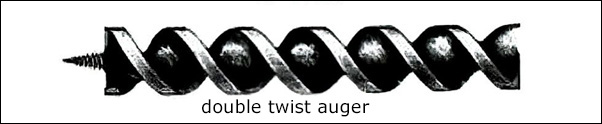
Double-Twist
Once referred to as a double-pod auger, a double-twist auger has two channels for moving chips up and away from the cutting head. It is traditionally formed by heating a piece of rod or bar stock, hammering part of it flat, and then twisting the flattened part of the stock to form a spiral. The honor for the first manufacture of the double-twist screw auger in North America likely goes to William Henry and John Henry Rauch of Lancaster County, Pennsylvania, men who put a commercially viable product on the market in 1772.(1)
Single-Twist
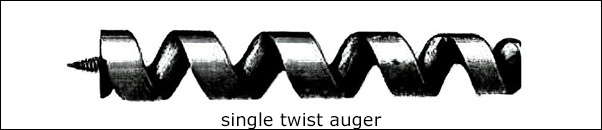
Sometimes referred to as a single-spiral auger, a traditional single-twist auger has a hollow center. Originally formed by wrapping a heated bar around a mandrel, twisting machines soon took over the laborious task. The advantage of the single-twist auger is its ability to clear chips from a deep hole. Double-twist augers have a tendency to clog in this situation, forcing a worker to remove the auger from the hole to clear the chips. Ezra L'Hommedieu is credited with developing the single-twist auger in 1816. A single-twist auger is sometimes referred to as a single-spiral auger.
Solid-Center
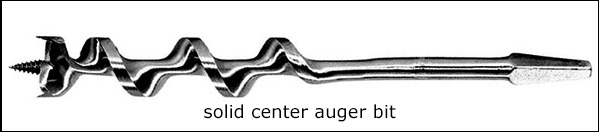
A solid-center auger bit features a thick, solid steel core providing increased rigidity and stability while boring. Originally patented by George Shetter with a single cutter in 1829, the inventor improved on his design in 1831 by adding a second cutter. Fifty-three years later, in 1884, William Demitt patented an auger virtually identical to that of Shetter's 1829 invention, and in 1887, Charles E. Irwin patented a double-cutter almost identical to that patented by Shetter in 1831. The original Shetter augers were not widely distributed, with the result that the later mass-produced version of his invention became known as the Irwin pattern.(2)
Scotch lip
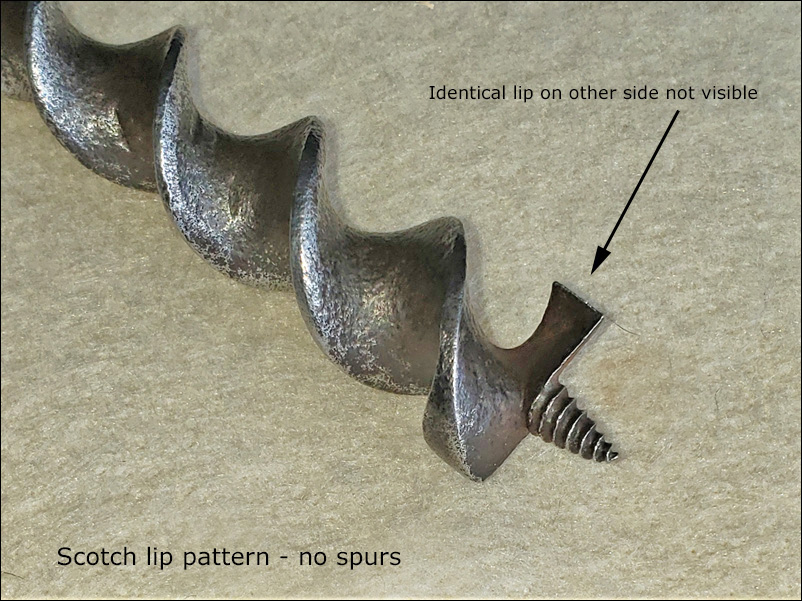
A Scotch lip auger typically features a pair of cutters with lips that project upward from the main cutting edges when the bit is held in the working position. The origins of the pattern have been lost to time, but the design is seen on American augers dating back to the latter decades of the 18th century.
Double spur
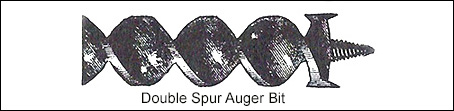
The term "double spur" can be confusing because it does not refer to an auger with two cutting spurs. Instead, it calls attention to a spur that protrudes both above and below the auger's main cutting edge or edges. Indeed, some bits were manufactured with a single double-spur. The development of the double-spur is not well documented. An early depiction of the double-spur appears in a patent drawing from 1831. The patent makes no claim for the originality of the spur.(3)
Extension Lip
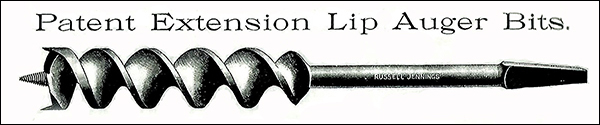
The term "extension lip" refers to the specific design of the spurs that extends beyond the auger's main cutting edges. Originally found almost exclusively on double-twist bits, the design was widely adopted after the expiration of Jennings' Patent, appearing in various forms on single and double-twist augers as well as solid-center bits. The extension-lip auger bit was patented by Russell Jennings in 1854.(4)
References:
- Hutchins, Joseph. "The American Screw Auger." The Chronicle of the Early American Industries Association. Vol. 64, no. 3 (September 2011), p. 92.
- Price, James E. “George Shetter, Father of the Solid Center Auger.” Chronicle of the Early American Industries Association, v. 46, no. 1, (March 1993), p. 20.
- Price, p. 20.
- United States Letters Patent No. 12,318 (January 30, 1855).