The Bit Players: h-z
HiCraft
A brand name for auger bits produced by the Midway Tool Company of Melvin, Ohio. Organized by former employees of the Irwin Auger Bit Company in 1946, the factory, with its two trip hammers, was located some half-dozen miles from Irwin's plant in Wilmington. The business remained in Melvin until 1955, when production moved to Sabina, Ohio. Boxes of its auger bits touted its "1,000 man years' experience."
Source: "New Company to Make Bits." Wilmington News-Journal (Wilmington, Ohio) January 21, 1947. p. 10.
Hudson Forge
HUDSON FORGE CO. was a hardware trademark first used by the W. T. Grant Company in 1923. The Grant Company operated a chain of variety stores situated in downtown locations. Slow to adapt to changes as American shoppers gravitated to suburban shopping centers, the company went bankrupt in 1976.
Jones, William
William Jones, of Portsmouth, Virginia, a shipbuilding hub, patented a device he referred to as a "hollow auger" on June 15, 1835. The Journal of the Franklin Institute published this description.(1)
The specification of this invention is brevity itself exemplified; it consists of the following words. "This invention is a hollow auger made so as to embrace the bolts or fastenings in ships or vessels, and to cut the wood from around them by which the plank, &c., can be removed without the delay, trouble, and expense, usually acquired by splitting them out."
In the drawing the auger is represented as twisted like the ordinary screw auger, but capable of allowing the bolt to pass within it. This must be a very useful thing, and, so far as we know, is new.
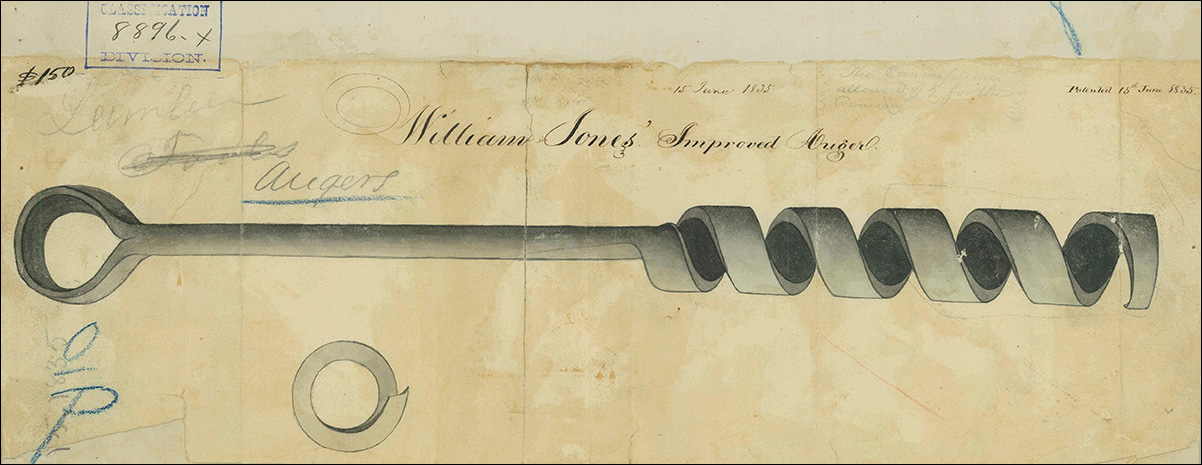
The record for Jones's patent was lost in the Patent Office fire of 1836. The fire destroyed the documentation for the 9,947 patents issued to date. Congress responded to the disaster by passing the Patent Act of 1837. The act declared the destroyed patents invalid unless the rights holders submitted their original documents or certified copies to the Patent Office. Upon receipt, the documents were transcribed, and when possible, the Patent Office artists recreated the original artwork that accompanied the patent application.
William Jones is a common name. A likely candidate for the William Jones who invented this early hollow auger is William A. Jones, a blacksmith living in Portsmouth, who perished in the city's infamous yellow fever epidemic of 1855. Examples of the Jones auger have yet to be discovered.
Illustration credit:
- Reconstructed Patent Office drawing of William Jones' improved auger. Drawing is undated.
References:
- “American Patents: List of American Patents Granted in June 1835.” Journal of the Franklin Institute, new series, v. 17, 1836. p. 49.
Ladd — W. J. Ladd Edge Tool Company
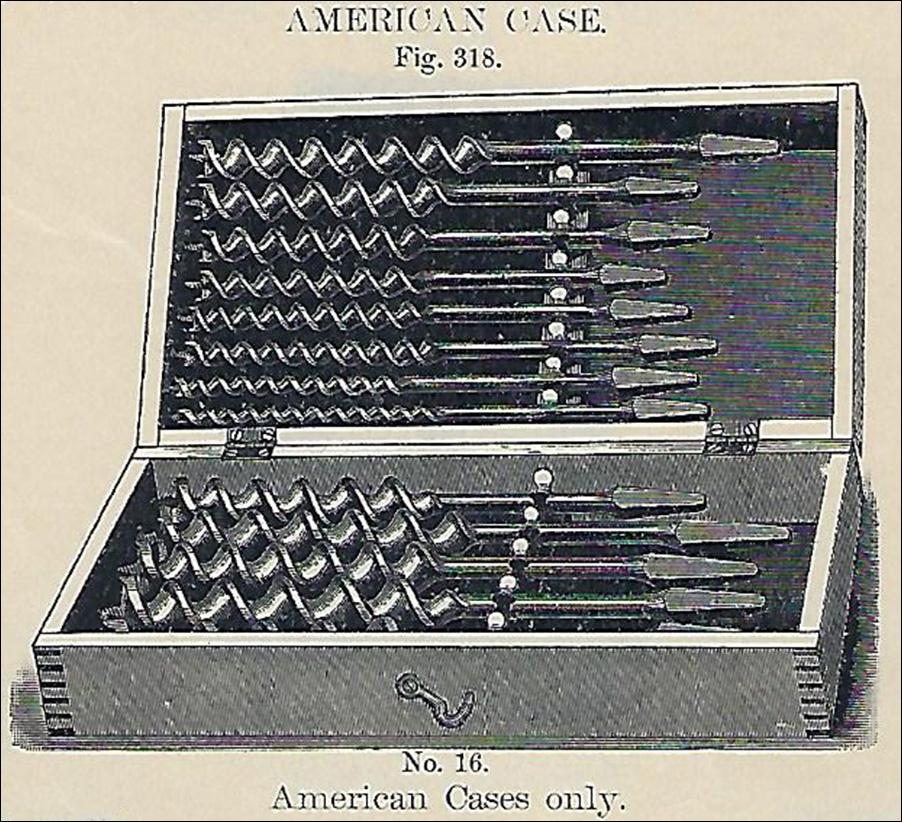
W. J. Ladd worked for Sargent & Company of New Haven, Connecticut, from 1856 through at least 1903. Sargent & Company catalogs for 1910 and 1911 contain listings for auger bits manufactured by Ladd. Sets of Ladd bits were sold in wooden American Case boxes.
Leland & Co.
In 1843, John P. and Samuel J. Leland began making augers at a site on the west branch of the Little River in South Charlton, Massachusetts. The village that grew up near their factory became known as Lelandville. The men manufactured bits and augers until 1861, when they began making ramrods for the United States federal government.(1) The Lelands' business appears to have folded some time before Henry Stevens of the Dudley Linen Works bought the factory in 1865. Leland augers and bits were typically of the double-spur design and stamped MFD. BY LELAND & CO. on the stem.
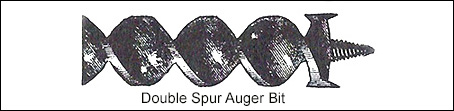
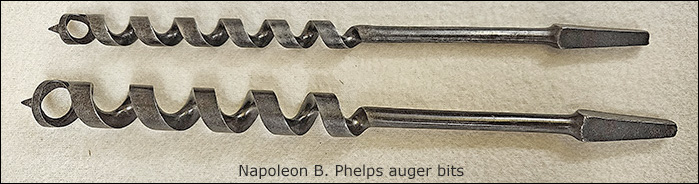
A notable exception to the company's regular production was the single-twist auger patented by the Lelands' brother-in-law, Napoleon B. Phelps, on December 27, 1859.(2) Phelps attached the auger's cutting lips to the coil just above them. His intent was to reduce the breakage of a bit's cutting edge during hard use. The Phelps design, a forerunner to the double-twist Cornelius Whitehouse bullnose pattern, did not take the world by storm. Though Phelps' patent documents claim rights to the design for both single and double-twist bits, surviving examples are of the single spiral variety. Leland & Co. stamped its Napoleon Phelps bits LELAND & CO. PAT'D. Dec 27, 1859.
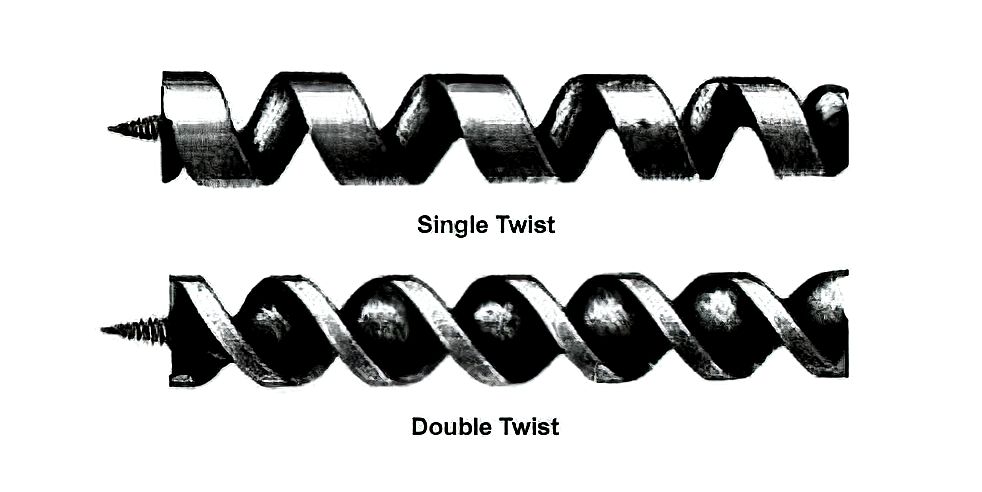
At some point, Phelps manufactured double-spur augers under his own name. The location of his factory and the years of production are unknown. Examples are stamped MFD. BY N. B. PHELPS.
Illustration credit:
- Phelps auger bits: author's photo.
References:
- Hurd, Duane Hamilton. History of Worcester County, Massachusetts: with Biographical Sketches ... Vol. 1 Philadelphia: J. W. Lewis & Co., 1889. p. 757.
- United States Letters Patent No. 26,613, (December 27, 1859).
M & M Co. (Morrison, McCargo & Co.) See Arrow brand
Naugatuck Valley Bit Company
Auger bits manufactured by the Naugatuck Valley Bit Company were distributed by the Russell & Erwin Mfg. Co., the company that for many years distributed the products of the James Swan Company, a major manufacturer of auger bits and chisels. There is some evidence that Naugatuck Valley bits were manufactured by the James Swan operation.

Sets of Naugatuck Valley bits were distributed in boxes patented by James Swan in 1886 and marked with the patent number (United States Letters Patent No. 337,888). Seymour, the headquarters of James Swan Company, is just seven miles from the junction of the Housatonic and Naugatuck Rivers in Derby, Connecticut.
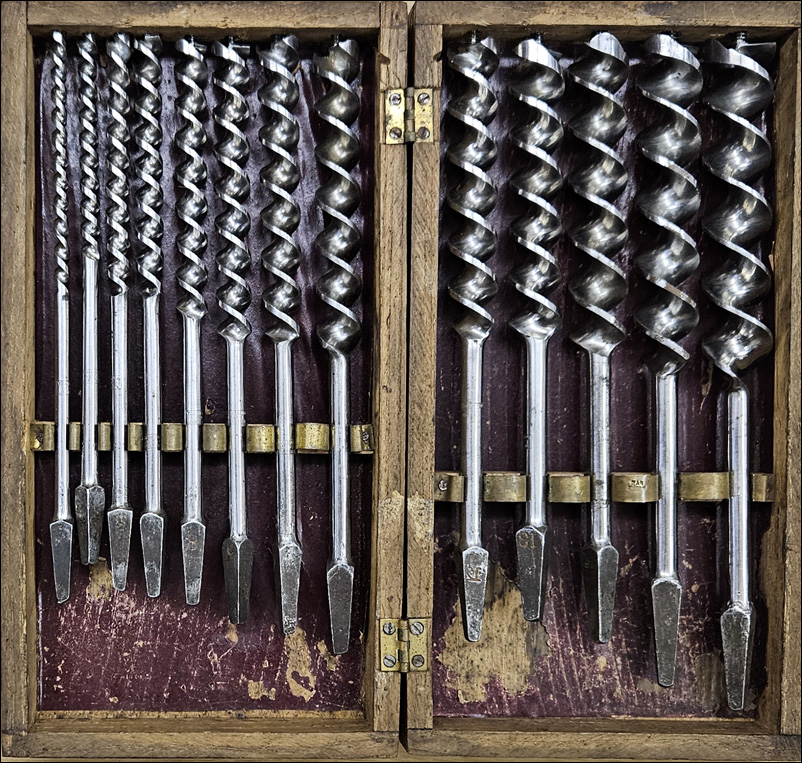
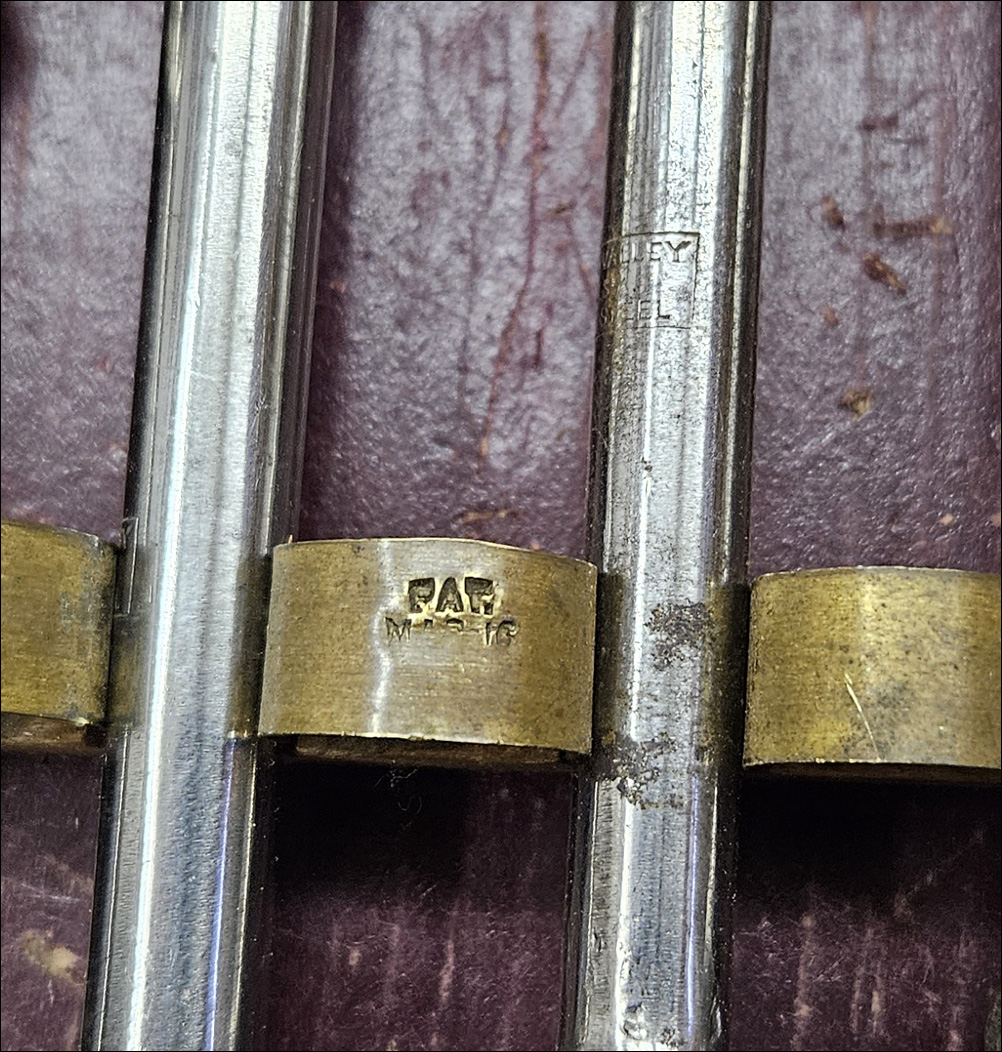
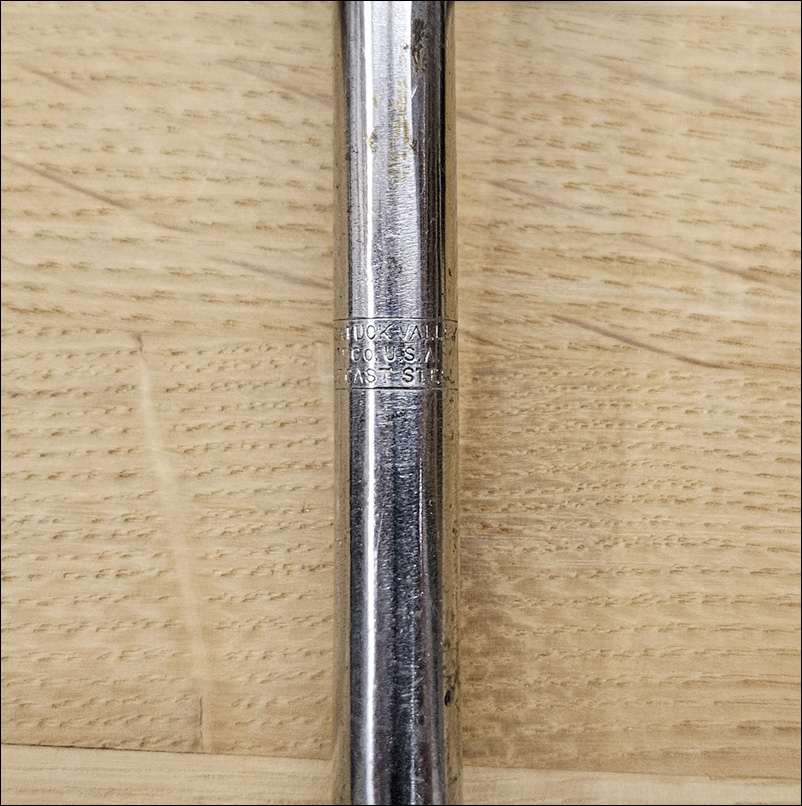
Illustration credit:
- author's photos
Poultney, James & John
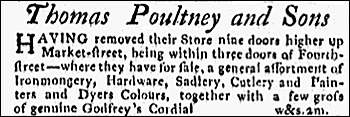 This article builds on Dan Linski's original research into the Poultney family.
John and James Poultney were sons of Thomas Poultney (ca. 1718-1800), an English immigrant who arrived in Philadelphia as a twelve-year-old. Their father was an ironmonger, a dealer in hardware and iron goods. There is no record of either he or his sons working as blacksmiths, though at the time, the distinction between making and retailing iron products was not set in stone.
Thomas brought his sons into the business. The first location of their enterprise is unknown, but by the early 1780s, they had set up shop on a rental property between Third and Fourth Streets owned by noted Philadelphian Benjamin Franklin.(1) By 1792, John & James Poultney had gone into partnership at No. 124 on the south side of Market Street. Their father, presumably, had retired. In addition to carrying local products, they sold a wide assortment of hardware items shipped to Philadelphia from England and Holland. Not all of their products consisted of ironware. The family sold raw steel, saddlery, paint, color pigments, panes of glass, and parts for clock manufacture and repair.(2)
The Poultneys were hard-shell Quakers. In 1783, Thomas and John signed a petition titled Memorial Against Theatres in Philadelphia, a document arguing for a ban on theaters within the city.(3) The signers were convinced that stage plays introduced "a variety of intemperance, dissoluteness, and debauchery" to the "open and visible detriment of true religion." A more meaningful involvement in public affairs took place when John and Thomas joined an organization with the lengthy name of "The Pennsylvania Society for Promoting the Abolition of Slavery and the Relief of Free Negroes Unlawfully Held in Bondage." Four years later, John Poultney became a leader in the society's petition campaign to convince state leaders to end Pennsylvania's involvement with the Atlantic slave trade.(4) The successful campaign filled a number of significant loopholes in the state's Gradual Abolition Act of 1780.
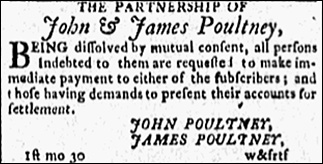
During the yellow fever epidemic of 1797, the Poultney brothers temporarily relocated their business from 124 Market Street in Philadelphia to Wilmington, Delaware. While not as deadly as the epidemic of 1793, which killed ten percent of Philadelphia's population, the Poultneys took no chances and became one of at least 19 businesses to leave the city.(5)
The change in location may have had something to do with the Poultneys' decision to part ways in 1799.(6) James Poultney went on to set up an ironmongery at 104 Market Street, 190 feet away from the location of the business he once shared with his brother. By 1801, John Poultney had moved into a space at No. 334 Orianna Street, an address once occupied by his father, Thomas Poultney. The elder Poultney had passed away in 1800.
Pictured here is an auger bearing the I. & I. POULTNEY stamp. (I. & I. being an archaic way of writing J. & J.) Since the brothers dissolved their business in 1799, the tool is from the 18th century. Given the scale of their hardware business, it is unlikely that either of the brothers forged and twisted the tool. The auger's early production date and square shaft bespeak American manufacture. The brothers likely contracted with a local smithery for the production and stamping of their augers. The auger seen here would have been manufactured anytime between the formation of their partnership circa 1790 and the dissolution of the business in 1799.
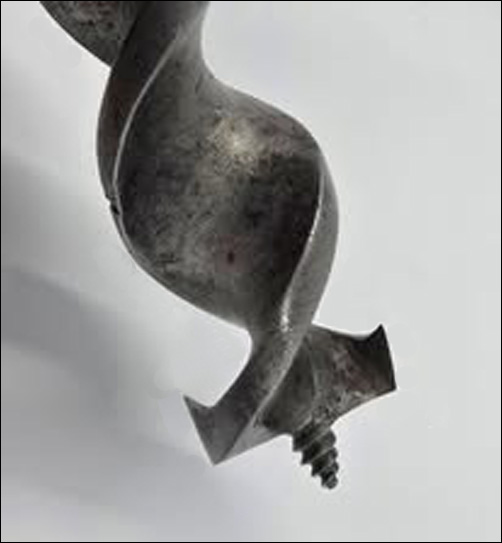
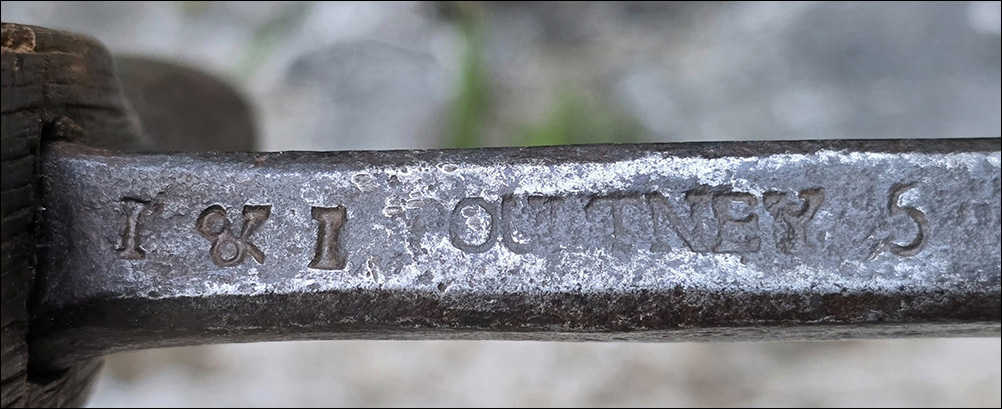
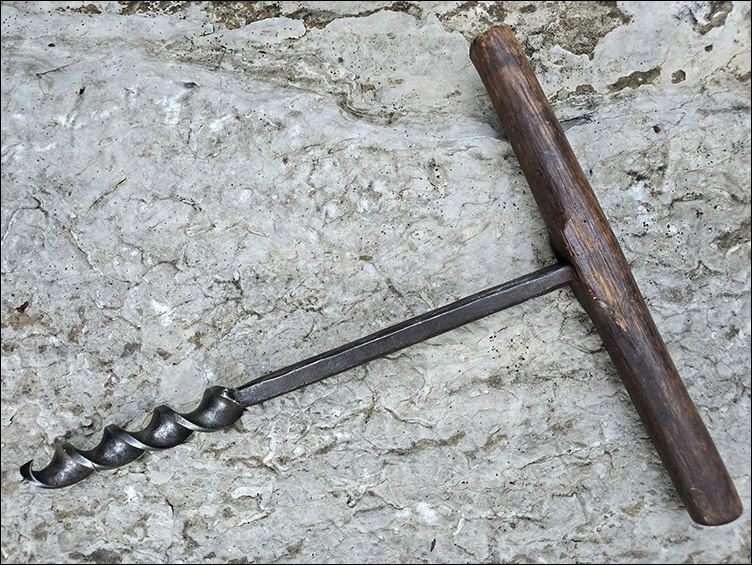
Illustration credits:
- Poultney & Son ad: [Advertisement]. Pennsylvania Packet (Philadelphia, Pennsylvania), no. 2272, May 17, 1786.
- Partnership dissolution: [Advertisement]. Gazette of the United States (Philadelphia, Pennsylvania), no. 1996, February 9, 1799.
- Poultney auger photos by Dan Linski.
References:
- Bache, Richard. "Cash Dr to Benjamin Franklin." Pennsylvania Magazine of History and Biography. v. 80 (January 1956), p. 46-73. Transcript from a daybook of Richard Bache, containing all entries relating to Franklin, 1772-92.
- "Advertisement."Dunlap's American Daily Advertiser(Philadelphia, Pennsylvania), no. 4281, October 15, 1792. p. 4.
- "Memorial Against Theatres in Philadelphia, 1783." Pennsylvania Archives: Selected and Arranged from Original Documents ... vol 10. Philadelphia: Joseph Severns & Co. p. 141-142.
- The information comes from a footnote appended to a transcription of "D. Broadley, Philadelphia, 1787," a document in Box 4A of the Pennsylvania Abolition Society Papers housed at the Historical Society of Pennsylvania. A digital version can be found at: https://hsp.org/history-online/digital-history-projects/pennsylvania-abolition-society-papers/habeas-corpus-actions/d-boadley-philadelphia-1787 (viewed October 20, 2025).
- "Advertisement." Aurora General Advertiser (Philadelphia, Pennsylvania), no. 2099, September 19, 1797. p 1.
- "Advertisement."Gazette of the United States (Philadelphia, Pennsylvania) XV, no. 1996, February 9, 1799. p. 4.
Rockford Bit Company
The Rockford Bit Company was founded in Rockford, Illinois, in 1886 by Robert Hall Tinker and Wilton C. Smith. In late 1887 or early 1888, the company bought the Ohio-based Ashtabula Auger Works. The ink was hardly dry on the papers when W. C. Smith bought Tinker's shares and became sole proprietor of the operation. In 1888, the company moved to Kokomo, Indiana. A brief article in the trade journal Iron Age noted:
W. C. Smith, secretary and treasurer of the Rockford Bit Company, Rockford, Ill., having recently purchased R. H. Tinker’s stock, has become sole proprietor. The company have lately bought the Ashtabula Bit Works, the two establishments being thus consolidated. Since then Mr. Smith has been considering the advisability of using natural gas, and in view of the advantages resulting from its use has decided to move the works from Rockford, Ill., and Ashtabula, Ohio, to Kokomo, Ind., where the company are now building a factory, storerooms, office, &c.
It is intimated that when the new works are completed the company will have a very convenient and well-arranged factory. The use of natural gas is referred to as enabling them to produce goods of exceptional quality. With the increased facilities thus given they will continue the manufacture on a larger scale than heretofore of their Perfection Auger Bits, special wood boring tools, machine bits, &c.(1)
Smith's choice of a location for his factory owed much to Kokomo's location in what was then referred to as the "natural gas belt." The site he chose, three-quarters of a mile from the nearest road, met with derision on the part of local historian Jackson Morrow, a surveyor who considered that Smith had been hoodwinked by local hustlers. Though the parcel was not close to town, it consisted of pieces of three adjoining farms owned by the men who showed him the property. They donated the land to Smith, likely in the hope that the new plant would increase the value of their adjacent properties. In Morrow's view, their self-interest did not compensate for the generosity of their actions. His opinion of the ethics of J. R. Hall, Wick Russell, and Garah Markland aside, Morrow provided one of the few contemporary descriptions of the Rockford Bit Company.
In 1892 Henry C. Davis and his son, Henry C., Jr., bought an interest in the factory. In 1893 they and H. A. Bruner bought in all outstanding stock. They manufacture augurs, augur bits and carpenter chisels. The present floor space is about 25,000 square feet. In 1892 the number of men employed was from thirty to forty. In 1908 the number is one hundred and fifty to one hundred and sixty, and the pay-roll is eighty thousand to one hundred thousand dollars per year. The capital stock is seventy-five thousand dollars. The officers are: H. C. Davis, president; H. A. Bruner, vice-president; H. C. Davis, Jr., treasurer; George L. Davis, secretary; George J. Costello, superintendent.(2)
By March of 1893, American augermakers were producing so many standard augers and bits that they had become a commodity. A soft economy only compounded the problem. A group of ten augermakers responded by forming the American Auger and Bit Association, an organization whose primary purpose was to set prices for various categories of augers, a practice sometimes referred to as price fixing. Rockford Bit became a charter member. Notable among the non-participants were the Irwin Auger Bit Company, whose unique designs were protected by patent, and the Russell Jennings Mfg. Company, whose bits commanded a premium. The organization remained active for some dozen years.(3)
Perhaps the best known of the Rockford Bit Company's bits were its "PERFECTION JENNINGS" augers. Sets of bits were put up in wooden American Case boxes. The company stamped much of its output with a single word, "ROCKFORD". Some of the company's double-spur bits bear the remarkably wordy designation ...
Workers at the Rockford Bit Company went on strike in 1916. The unintended consequence of their action was that the business folded. Greenlee Brothers & Company bought the company’s assets and moved the stock and equipment to Rockford, Illinois, the following year. The articles of dissolution for the Rockford Bit Company were filed on August 13, 1917, in Indiana.
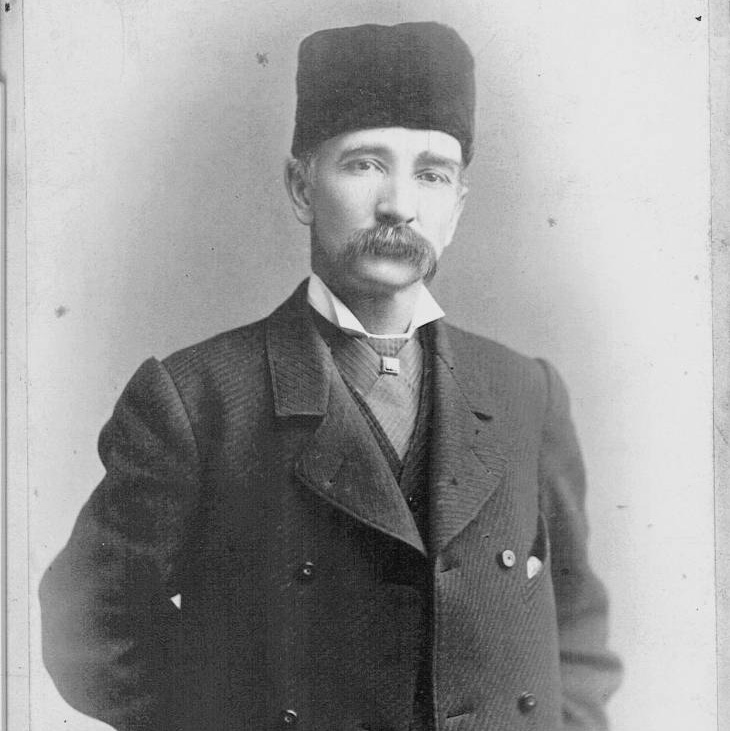
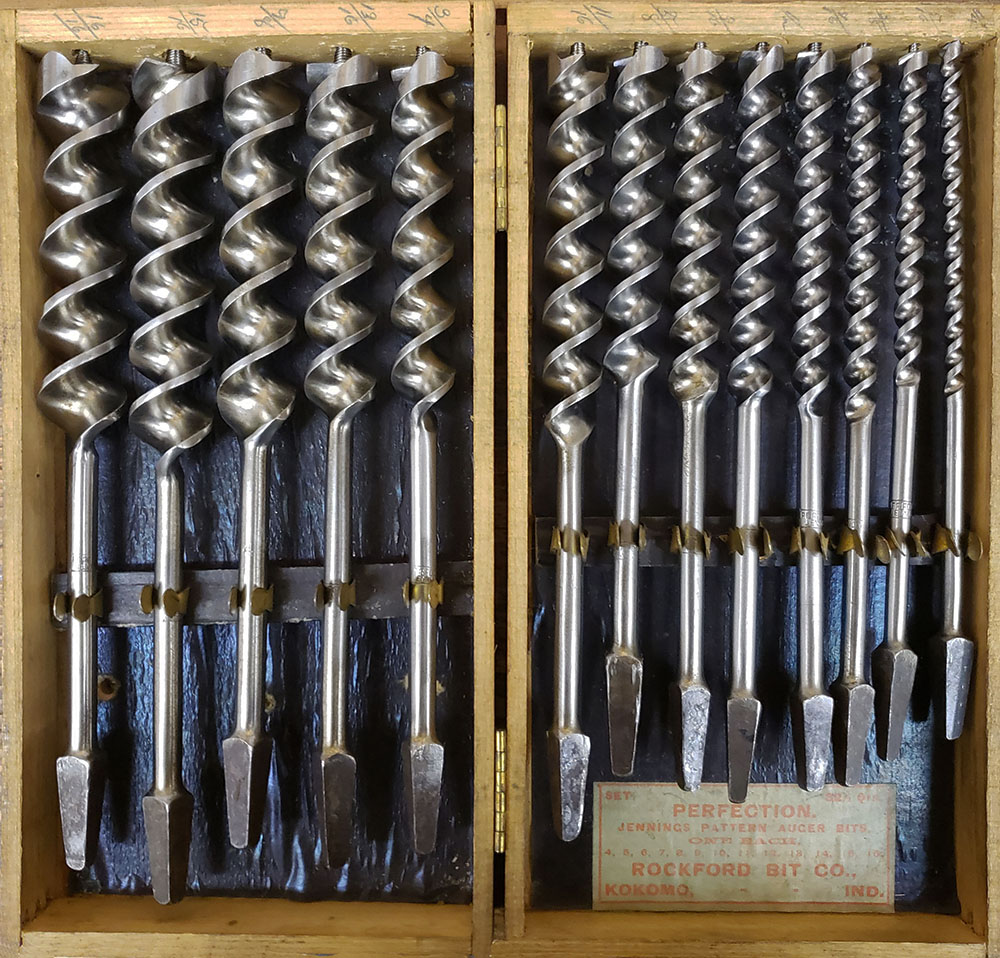
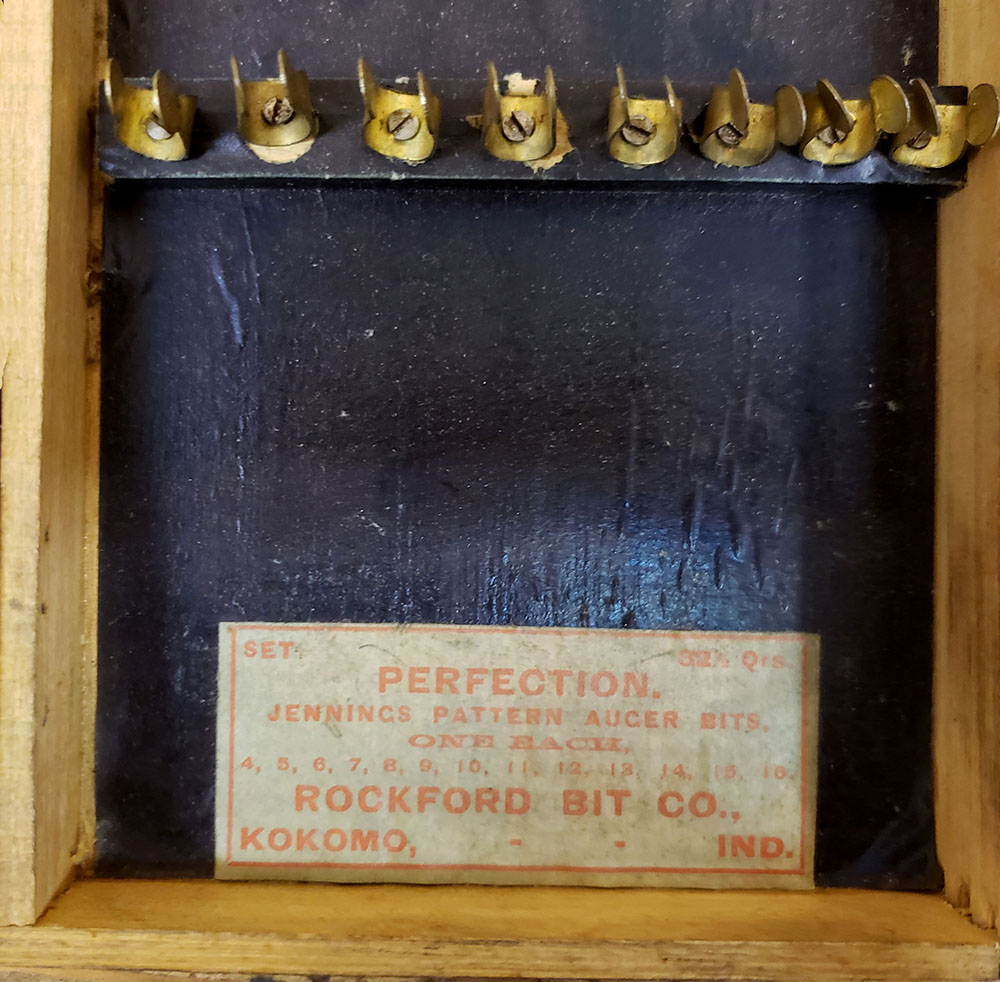
Illustration credits:
- Robert Hall Tinker: "Robert H. Tinker." Rockford Public Library: Tinker Swiss Cottage (Illinois Digital Archives) (viewed March 22, 2023)
- Perfection Jennings images: author's photos
References:
- "Items." Iron Age. July 17, 1888. p. 68.
- Morrow, Jackson. History of Howard County, Indiana. Vol. 1. Indianapolis: B. F. Bowen, [1909?]. p. 242-243.
- "Augers and Bits." The Iron Age. (March 16, 1893). p. 635.
Sanford, Nathaniel C. (N. C. Sanford & CO.)
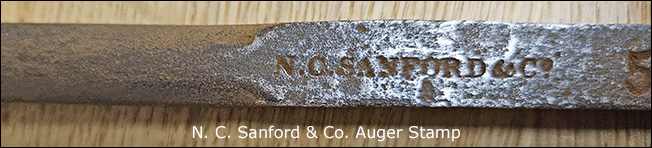
The story of Nathaniel C. Sanford's inventiveness and his involvement in nineteenth-century American auger manufacture is a convoluted one, involving a number of players and no less than eight different companies. The names of the entities involved in the tale and their approximate dates of operation are:
- N. C. Sanford & Company (1826-1833)
- Tibbals, Bush & Company (1833-1835)
- Tibbals, Brooks & Company (1835-1840)
- Sanford, Newton & Company (1845-1847)
- Sanford, Parmelee & Company (1847-1856)
- N. C. Sanford & Company, 2nd iteration (1856-ca. 1860)
- Eagle Auger and Skate Company (ca. 1860-ca. 1865)
- E. H. Tracy (ca. 1865-1880)
Nathaniel C. Sanford was one of seven men who established an auger-making enterprise in Meriden, Connecticut, during the fall of 1826.(1) The other investors included: Julius Pratt, Erastus P. Parmelee, Fenner Bush, Howell Merriman, Edward Sanford, and Elisha A. Cowles. The bulk of the operation's output was marketed by an entity known as N. C. Sanford & Company, the firm's accredited sales agent. Six months later, the company leased a factory on Harbor Brook from investor Elisha A. Cowles. Unfortunately, the small stream in West Meriden proved an unreliable source of power. In 1832, the operation bought the factory of Carter, Goodrich & Bishop, makers of bone buttons, located on the much larger Quinnipiac River.(2)
The original investors in the auger-making operation parted ways in the spring of 1833. Nathaniel C. Sanford, Julius Pratt, Erastus P. Parmelee, Howell Merriman, and Edward Sanford sold their shares in the company. A smaller group of investors composed of Elisha A. Cowles, Fenner Bush, Walter Booth, and Isaac I. Tibbals, acquired the assets of the operation and formed a new enterprise: Tibbals, Bush & Company. Tibbals & Bush took on the manufacture of N. C. Sanford & Company's product line: rakes, augers, and bits.(3) The business reorganized in 1835 to became Tibbals, Brooks & Company. This new iteration of the firm was short-lived and went out of business about 1840.
During the 1830s, the United States Patent Office issued four patents to Nathaniel C. Sanford. The first was for a curry comb. Sanford co-patented the second, an iron-tooth rake, with Erastus P. Parmelee in 1830. The third of Sanford's patents, an ice skate, and the fourth, an auger, were awarded in 1834—the year after the original, short-lived N. C. Sanford & Company broke up.(4) The drawings of the 1834 skate have disappeared, and it is not known to have been manufactured. Sanford's 1834 auger patent added a second cutting lip to the single spiral auger invented by Ezra L'Hommedieu. (L'Hommedieu's patent expired in 1830.)
In August 1834, Isaac I. Tibbals—of Tibbals, Bush & Company—witnessed a patent application for an auger developed by Meriden resident Alfred Newton. Newton's auger was unusual in that it had three cutting lips and three channels for the clearing of wood chips. Tibbals & Brooks manufactured the design for a time, but it never caught on, and examples are few.(5)
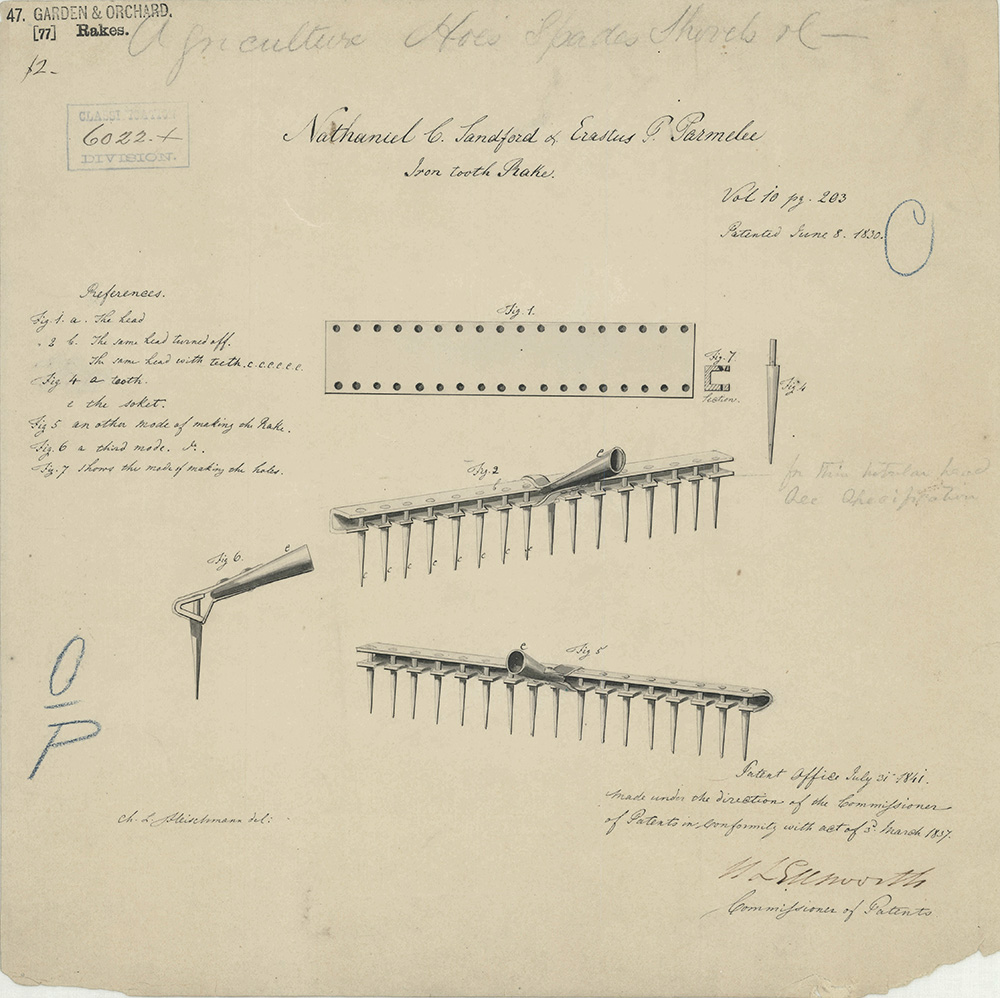

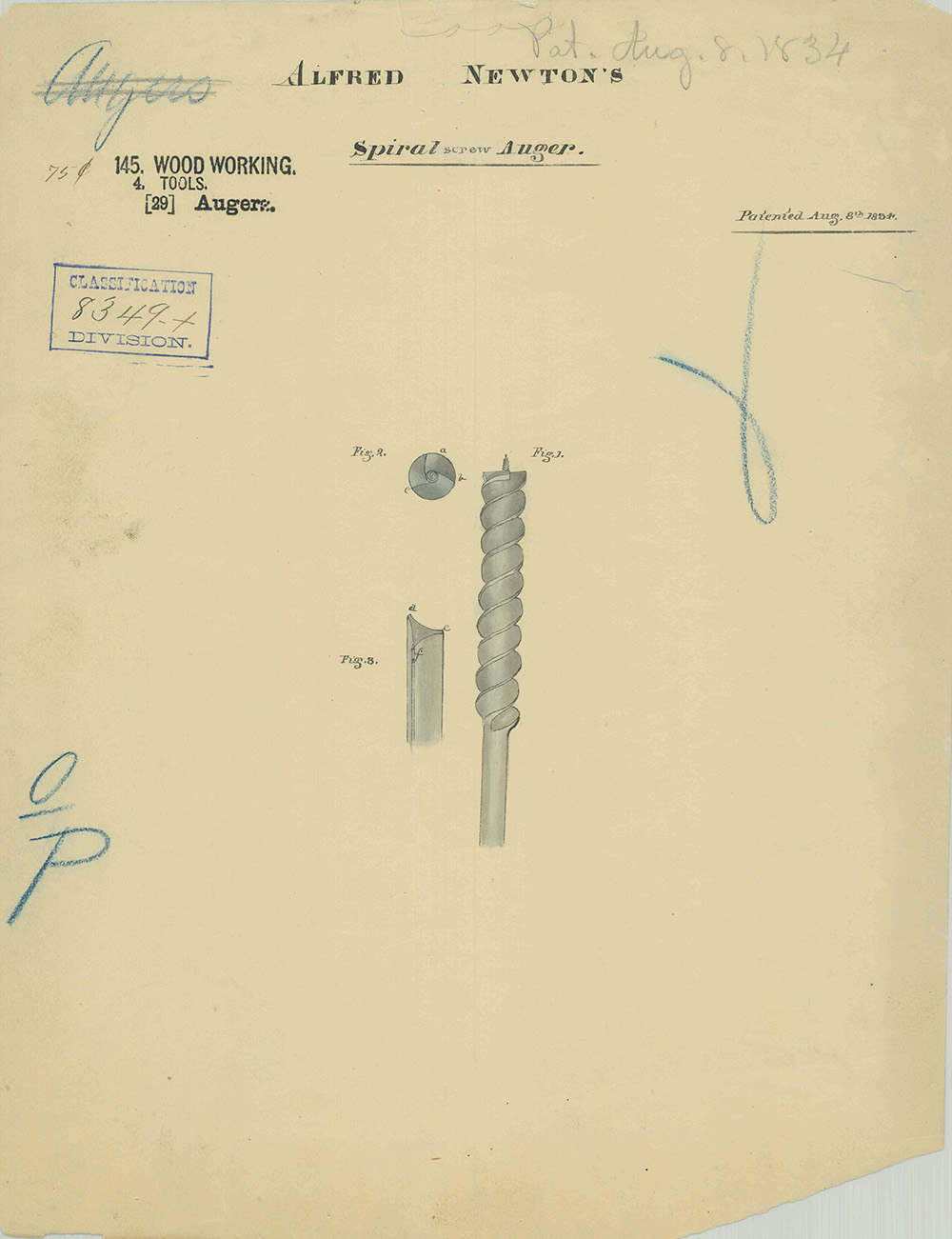
The records for the early Nathaniel Sanford and Alfred Newton patents were lost in the Patent Office fire of 1836. The fire destroyed the documentation for the 9,947 patents issued to date. Congress responded to the disaster by passing the Patent Act of 1837. The act declared the destroyed patents invalid unless the rights holders submitted their original documents or certified copies of them to the Patent Office. Upon receipt, the documents were transcribed, and when possible, the Patent Office artists recreated the original artwork that accompanied the patent application. The artwork then became the basis for the line drawings found in official Patent Office publications. The United States Congress ended the effort in 1847 when it discontinued the funding. By that time, employees had recreated 2,845 of the destroyed patents.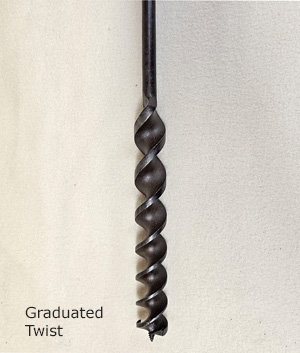
It is uncertain just how quickly Sanford involved himself in another business after selling his interest in N.C. Sanford & Co., but sometime before 1845, Nathaniel C. Sanford and Alfred Newton joined forces to form Sanford, Newton & Company. Their factory was located on the Quinnipiac River, a half-mile downstream from that of Tibbals, Brooks & Company. In 1845, Sanford & Newton are on record as the manufacturers of "augers, rakes, etc." worth a total of $20,000 and as employers of 28 hands.(6) When Alfred Newton, Lucius B. Smith, and Elias Sanford patented an innovative auger with a graduated twist on March 27, 1847, Sanford, Newton & Company manufactured it.(7) The inventors maintained that the wider channels at the top of the twist facilitated the passage of chips, leading to less clogging and minimizing the time required to pull the auger out of a hole to clear a blockage. The patent covered the use of the graduated twist on both single and double-twist augers.
The team that developed the graduated twist auger knew each other well. Newton had been a partner in Sanford Newton & Company; Elias Sanford was Nathaniel Sanford's half-brother; and Lucius B. Smith was raised by his maternal uncle, Erastus Parmelee, from whom he learned blacksmithing. Erastus P. Parmelee became a co-owner of the business when Alfred Newton died at age forty-one, just two months after co-patenting the graduated twist auger. The reorganized enterprise became Sanford, Parmelee & Company. Historical mentions of the business are scarce. Like its predecessor, the company manufactured bits, rakes, and skates, and it employed some forty hands.(8) Its augers were stamped SANFORD, PARMELEE & CO.
In 1849, N. C. Sanford patented two additional auger-making ideas. The first, United States Letters Patent No. 6,221, covered a methodology for producing the graduated twist auger. Shortly afterward, Sanford co-patented an auger-making machine with Erastus Parmelee's nephew, Lucius B. Smith.
By 1856, the name of the business had reverted to N. C. SANFORD & COMPANY, at about the time Erastus P. Parmelee left the area.(9) The 1860 federal census finds Parmelee living in Broadalbin (Fulton County), New York, working for a mitten manufacturer. By the time of the 1865 New York State census, he was still living in Fulton County, working as a machinist in Johnstown.
Between 1856 and 1868, Sanford patented an auger handle and two augers. United States Letters Patent No. 15,147 protected a handle for a ring-type auger featuring a threaded plate attached to the lower side of the ring. A bolt passing through the wooden handle engaged the threads, providing a secure, non-slip way to attach it to the ring. Letters Patent No. 36,534 covered an auger with supplemental lips for boring through end grain. His final patent, Letters Patent No. 79,012, protected an auger with "two or more cutting lips ... of different radial distance from the axial center of the auger." However interesting the drawing accompanying the award might be, the patent did not indicate what the advantages of such an arrangement would be. It appears none of the three patents made it into production.
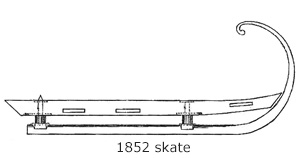
During the 1850s and 1860s, N. C. Sanford continued to patent and manufacture ice skates in addition to augers and bits. His designs were successful, and skates based on his 1852 patent(11) are considered nothing less than works of art. Sanford & Co. continued making augers and skates until Clark, Wilson & Co. bought the business shortly before the American Civil War. The New York-based hardware firm operated the enterprise as the Eagle Auger and Skate Company. In the mid-1860s, Clark & Wilson sold the business to Edward H. Tracy, who stamped his augers E. H. TRACEY and continued to manufacture augers and skates under that mark until 1880.
Born in 1796 in Old Saybrook, Connecticut, Nathaniel Clark Sanford died in Bricksburg, New Jersey, on December 11, 1877.
Illustration credits:
- Reconstructed United States Patent Office drawing of rake "made under the direction of the commissioner of patents in conformity with act of 3rd March 1837." Drawing dated July 31st, 1841.
- Reconstructed Patent Office drawing of Nathaniel C. Sanford twist auger. Drawing is undated.
- Reconstructed Patent Office drawing of Newton graduated twist auger. Drawing is undated.
- Graduated twist auger: author's photo.
- 1852 ice skate: United States Letters Patent No. 9,079, (June 29, 1852).
References:
- Davis, Charles Henry Stanley. History of Wallingford, Conn., from its Settlement in 1670 to the Present Time. Meriden, Conn.: published by the author, 1870. p. 162.
- Gillespie, Charles Bancroft (compiler). An Historic Record and Pictorial Description of the Town of Meriden, Connecticut and Men Who Have Made It. Meriden, Conn.: Journal Publishing Company, 1906. p. 356.
- "Notice." Hartford Courant (Hartford, Connecticut). April 9, 1833. p. 1.
- The curry comb: United States Letters Patent No. 997X; the rake: United States Letters Patent No. 6022X; the skate: United States Letters Patent No. 8051X; the auger: United States Letters Patent No. 8350X.
- Nichols, Nick. "In Search of the Three-Lipped Auger." Chronicle of the Early American Industries Association. Vol. 59, No. 3 (September, 2006) p. 109-110.
- Gillespie, p. 306.
- United States Letters Patent No. 6,305, (April 10, 1849).
- Davis, p. 495.
- The Connecticut Business Directory: Giving the Names and Post Office Addresses ... Boston: George Adams, 1856. p. 18.
- United States Letters Patent No. 9,079, (June 29, 1852).
Upson, Hiram
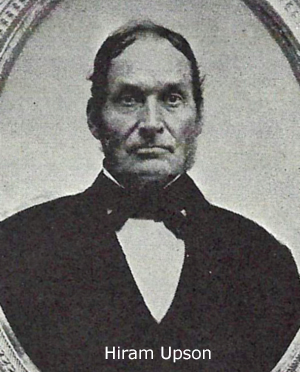
At some point in the 1820s, Hiram Upson, a native of Wolcott, Connecticut, made the thirty-mile trip to the town of Derby to seek his fortune. Derby, located at the junction of the Naugatuck and Housatonic Rivers, was home to Walter French, an early manufacturer of double-twist augers who is sometimes credited with developing the tool. French set up shop there in 1810 in an area known as Humphreysville (later renamed Seymour).
Little is known of Upson’s early years in his new home, but in 1839, he associated with Raymond French in an augermaking enterprise. The pair bought two pieces of real estate from John C. Wheeler, French’s former partner in an auger-making business.(1) French and Upson began manufacturing augers and bits in a former machine shop located on their property and built in 1832. Their business is the source of the rarely seen augers stamped "FRENCH & UPSON".
When fire destroyed the buildings located on the French & Upson property in 1841, work on replacements began at once.(2) The event may have precipitated Hiram Upson's departure from the business and Raymond French's decision to partner with Timothy Dwight to form Raymond French & Company (later Dwight and French, later still Dwights, French & Company).(3)
An 1849 village directory lists Hiram Upson as an independent business owner working in a shop on the Little River in Humphreysville.(4) Though he remained in place, his address changed the following year when the Connecticut General Assembly changed the name of the village to Seymour.
In 1852, Upson joined Horace A. Radford and Lucius Tuttle to form the Upson Manufacturing Company, an enterprise organized with a capital of $6,000. The men set up shop at the mouth of the Little River in a building originally built by Timothy Dwight, Sr. and sold by his heirs to Radford in 1837.(5) Upson Manufacturing employed some twenty hands on average, fired four forges, and operated two trip hammers.(6) The augers it produced are marked "UPSON MFG. CO." It appears that the owners dissolved the business in 1859 when H. A. Radford sold the property to Charles Douglass, and it became the site of the Douglass Manufacturing Company.
Though Upson still considered himself an auger manufacturer at the time of the 1860 federal census, corroborating evidence is unavailable. Augers marked "H. UPSON" likely originate from that period or the years before he partnered with Raymond French. Upson reported he was a farmer at the time of the 1870 census. He died in 1874.
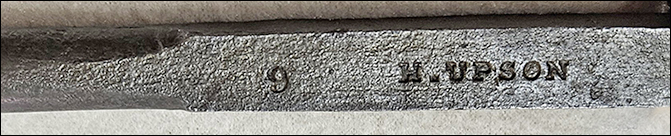
Illustration credits:
- Hiram Upson tintype reproduction: Portrait Painting in America: the Nineteenth Century. New York: Mainstreet/Universe Press, 1977.
- H. Upson stamp: author's photo.
References:
- Sharpe, William C., Seymour and Vicinity: Historical Collections. Seymour, Conn.: Record Print., 1878. p. 73.
- Rockey, J. L., ed. History of New Haven County. vol. 2. New York: W. W. Preston, 1892. p. 574.
- Sharpe, p. 49.
- Sharpe, p. 79; Rockey, p. 575.
- Sharpe, p. 87.
- “Industrial Statistics.” The Plough, the Loom, and the Anvil. v. 8, no. 7. (January 1856) New York: [publisher not given], p. 418.
Watrous & Company
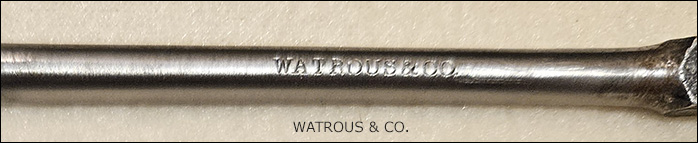
In 1832, eighteen-year-old Richard N. Watrous went to work for the L'Hommedieu brothers, well-known augermakers in his hometown, Chester, Connecticut.(1) A talented youth, he became the operation's foreman at age twenty-one, and co-patented a device for making double-twist augers with Ezra L'Hommedieu in 1838.(2) At some point, Watrous assigned his rights to the augermaking machine to L'Hommedieu, who had the patent reissued in 1845, a move likely prompted by Watrous's relocation to Charlestown, Ohio, the previous year. There, Watrous joined three other men from Connecticut's Chester/Deep River area—Levi B. Southworth, Ansel Shipman, and his brother Justin Watrous—in organizing Watrous & Company, an augermaking business. They set up shop some six miles east of Ravenna in an area that became known as Augerburg.
In 1857, R. N. Watrous patented an adjustable-handled drawknife that allowed a user to adjust the angle of the blade to fit the task at hand.(3) Shallow cuts facilitated work with hardwoods, and deeper cuts allowed for the aggressive removal of softwood stock. Watrous & Company began making the drawknife. Eventually manufactured by both the C. E. Jennings and James Swan companies, the tool remained in production for the next half-century.
The business reorganized as Watrous, Shipman & Company when Levi Southworth left in April 1858. His was not an amicable departure. Southworth left his partners with an uncollectible promissory note for $5,193.12—a substantial sum at the time. The matter went to the Portage County, Ohio, Court of Common Pleas. Its disposition remains unknown.(4) Watrous, Shipman & Company continued doing business in Augerburg, making bits, ship augers, and drawknives until the second year of the American Civil War, when the principals dissolved the business.
In 1866, after the cessation of hostilities, the Watrous brothers and Shipman relocated to Elmira, New York, where Milton V. Nobles had just organized a business for the manufacture of bit braces and specialty carpenters' tools. Shipman soon became superintendent of the plant, R. N. Watrous spearheaded the auger operation, and Justin Watrous worked in the finishing department. In addition to turning out tools under its own name, Nobles Manufacturing Company made augers, bits, and draw knives under the Watrous & Co. name. The operation's Watrous-branded ship augers sold especially well, garnering a worldwide reputation.
Milton V. Nobles sold his interest in his company in April 1871, and a new group of investors reorganized the business as the Elmira Nobles Manufacturing Company. Richard N. Watrous stayed on at the factory, and four months later patented an improved die for forming the lips of auger bits.(5) His idea was sound and incorporated into the production of bits manufactured by the company.(6)
R. N. Watrous was still at his job in 1877 when the buildings and machinery were sold at auction. Solomon L. Gillet and Robert T. Turner either bought the operation or rented the plant from someone who did and formed Gillet & Co. The Gillet operation continued making Watrous-branded augers, draw knives, and bits until January 1886, when C. E. Jennings & Company rented the factory. Though R. N. Watrous, by then retired, passed away the next September, C. E. Jennings & Company continued the Watrous brand. When fire destroyed the Elmira factory in 1887, production of Watrous brand tools moved to Meriden, Connecticut.(7) Early on, C. E. Jennings' publicity portrayed the company as an independent entity. Jennings began treating its acquisition as a brand in the early 20th century, marking the bits with the word WATROUS in quotation marks.
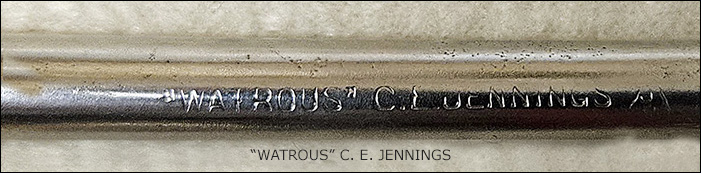
Illustration credit:
- Watrous bit stamps: author's photos.
References:
- "The Late Richard Watrous." The Democratic Press (Ravenna, Ohio) September 2, 1886. p. 3.
- United States Letters Patent No. 851 reissued as RE72.
- United States Letters Patent No. 18,887.
- "Dissolution of Copartnership." The Portage Sentinel (Ravenna, Ohio) May 20, 1858. p. 3; "Legal Notice." The Portage Sentinel (Ravenna, Ohio) July 29, 1858. p. 3.
- United States Letters Patent No. 117,838.
- "Abram M. Dewitt vs. Elmira Nobles Manufacturing Company." in Reports of Cases Heard and Determined in the Supreme Court of the State of New York. Vol. 12. New York : Banks & Brothers, 1876. p. 301.
- Towner Ausburn. Our County and Its People: a History of the Valley and County of Chemung ... Syracuse, New York: D. Mason & Co., 1892. p. 607.
Wilson, Joseph (J. Wilson)
Born in 1770, possibly in Brookfield, Massachusetts, Joseph Wilson moved to Marlborough, New Hampshire, where he worked as a blacksmith.(1) A skilled mechanic, his shop turned out augers and such agricultural implements as potato hooks and hoes. The United States Patent Office awarded him a patent for an improvement to the prong of a hoe on September 20, 1827.(2) His house straddled the boundary line between the towns of Marlborough and Keene. He once avoided arrest by walking from the Keene piece of his home into the Marlborough part, where the Keene constable had no authority to detain him. He was known to stamp his augers J. WiLSON with a lower case "i."
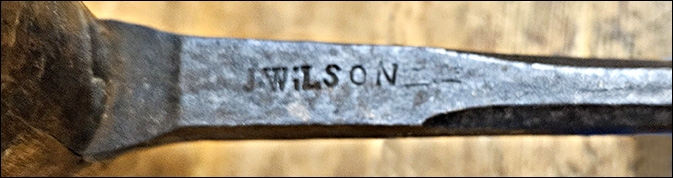
Illustration credit:
- Wilson auger stamp: author's photo.
References:
- Bemis, Charles A. History of the Town of Marlborough, Cheshire County New Hampshire. Boston: Press of G. H. Ellis, 1881. p. 699.
- Nelson, Robert E. Dictionary of American Toolmakers. [Place of publication not given]: Early American Industries Association, 1999. p. 868.