The Bit Players: a-g
Arrow brand
Arrow brand bits were manufactured by a series of Philadelphia-area businesses from 1866 to 1918.(1) The first of these was Dewitt, Morrison & Kelley, an entity organized by William T. Morrison (1842-1919), Emanuel Dewitt (1835-1908), and a not-yet-identified partner named Kelley. Based in Philadelphia proper, the company's primary products were augers and bits manufactured from first-quality British cast steel.(2) Its auger bits, with the manufacturer's identification imprinted on the tang and an unpolished black twist, were typical of Eastern Pennsylvania. A simple, feathered arrow impressed on the stem gave nod to the brand name, and the tangs of its bits bore the acronym D. M. & K. PHILA. Sets of its auger bits were sold in wooden boxes equipped with an ornate, hinged bit holder that featured an arrow cast into its top.
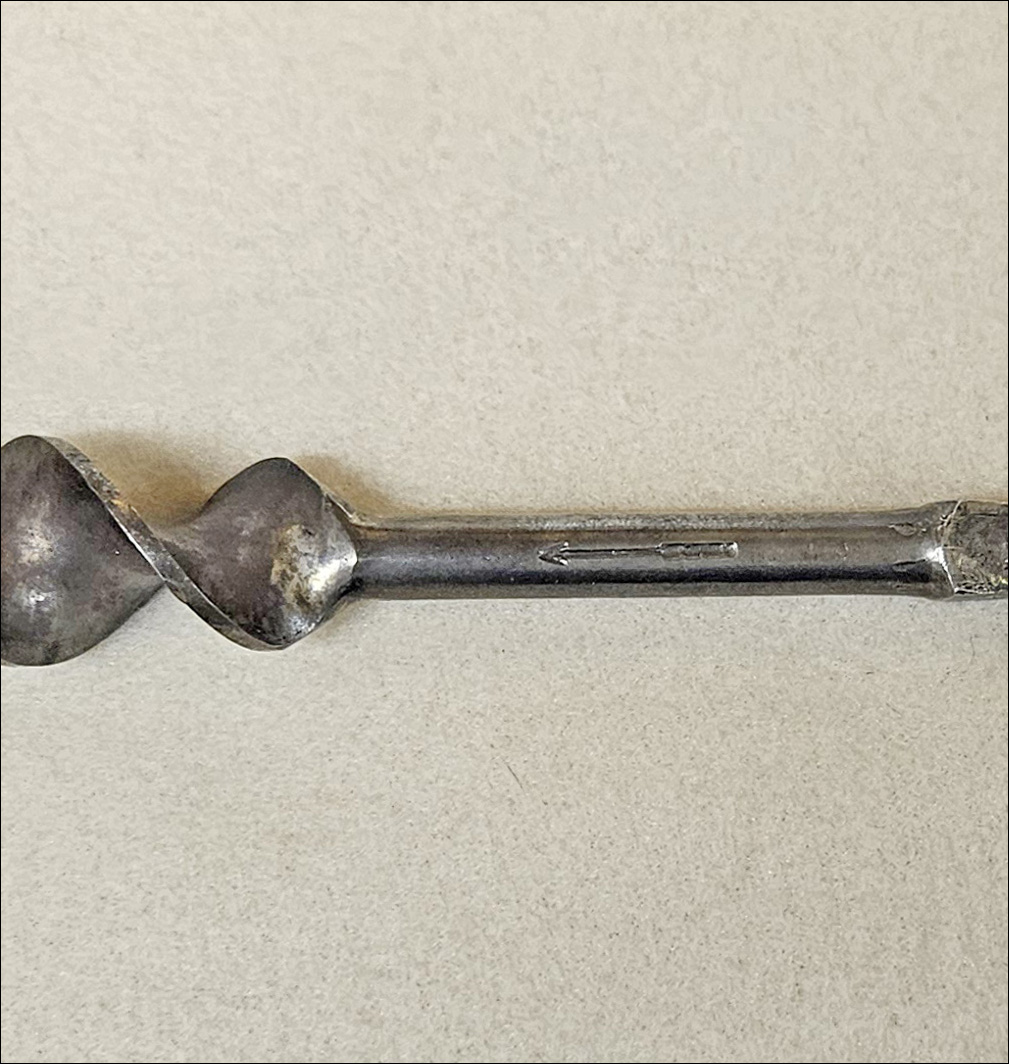
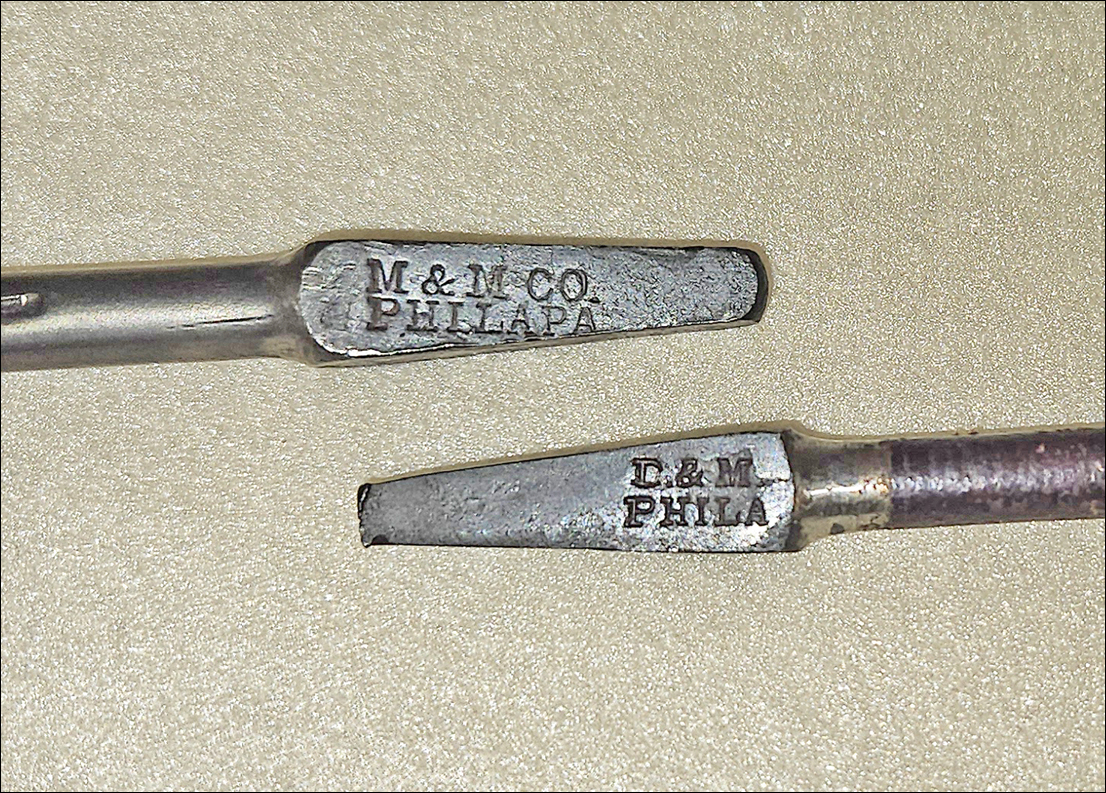
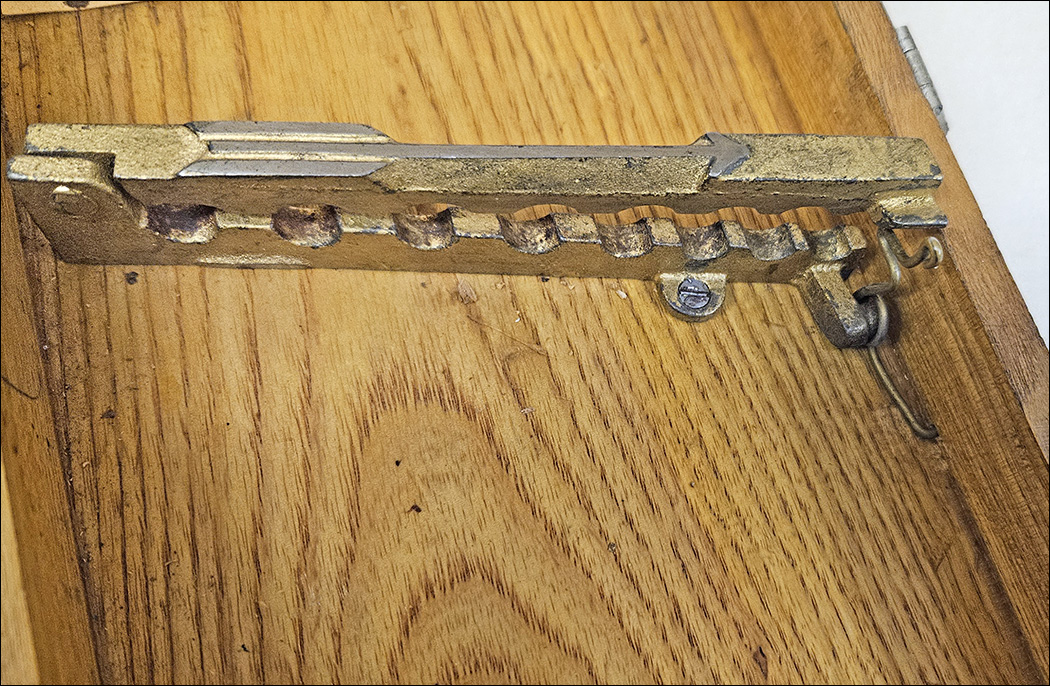
By 1897, Kelley was no longer with the business, and the firm became Dewitt & Morrison.(3) The partners continued to use their unique bit box and mark the stems of their black-twist bits with an arrow. The tangs of the bits were now stamped D. & M. PHILA. Dewitt & Morrison soon relocated the business to Darby, a suburb just outside Philadelphia.
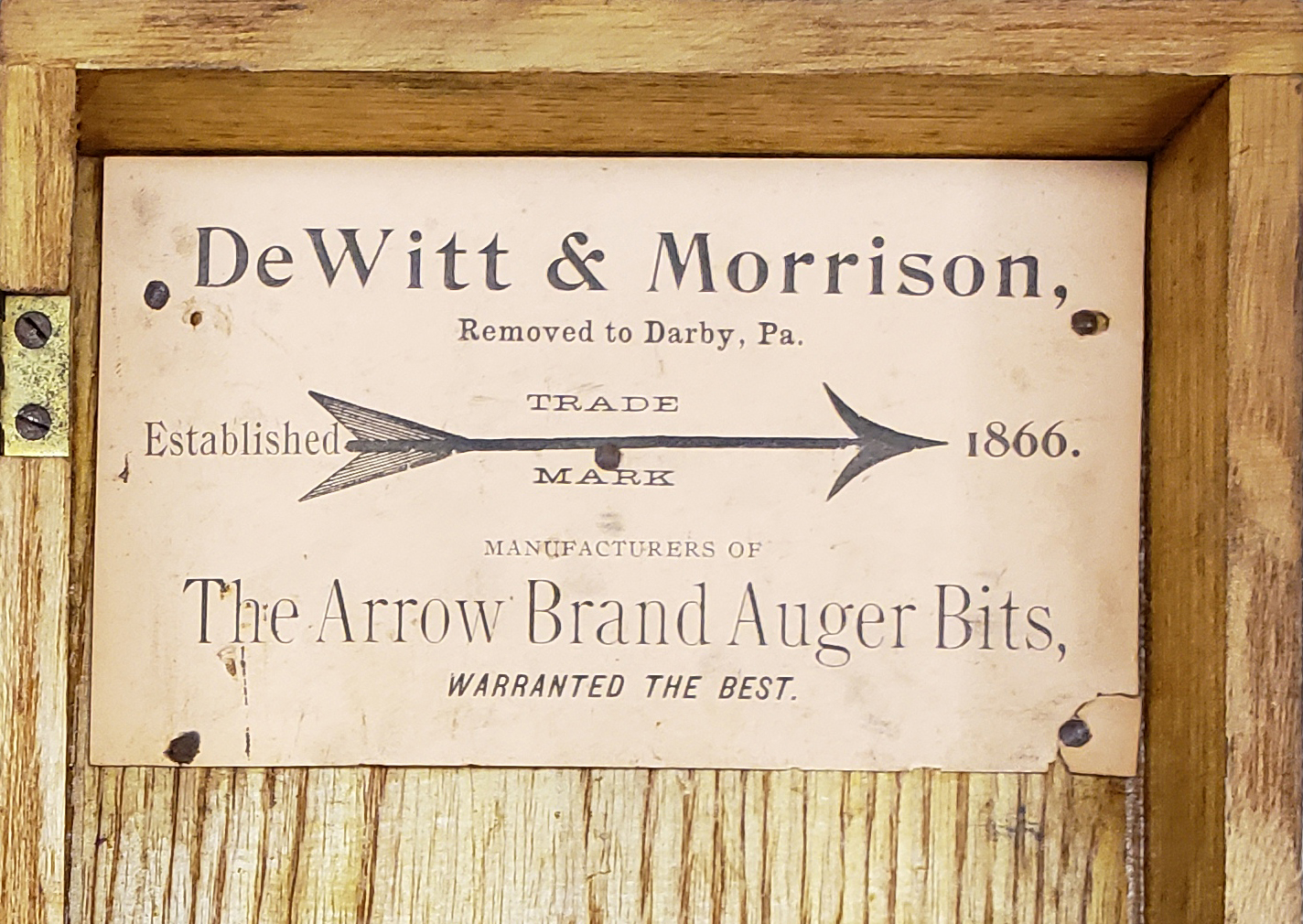
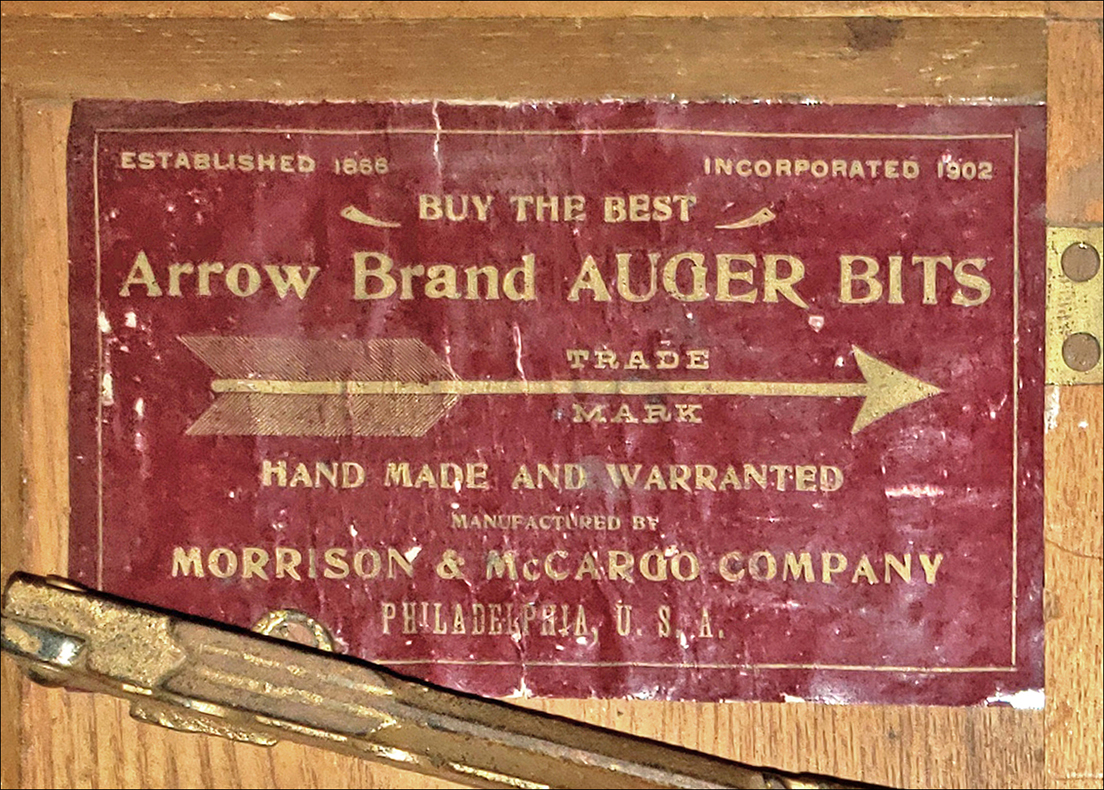
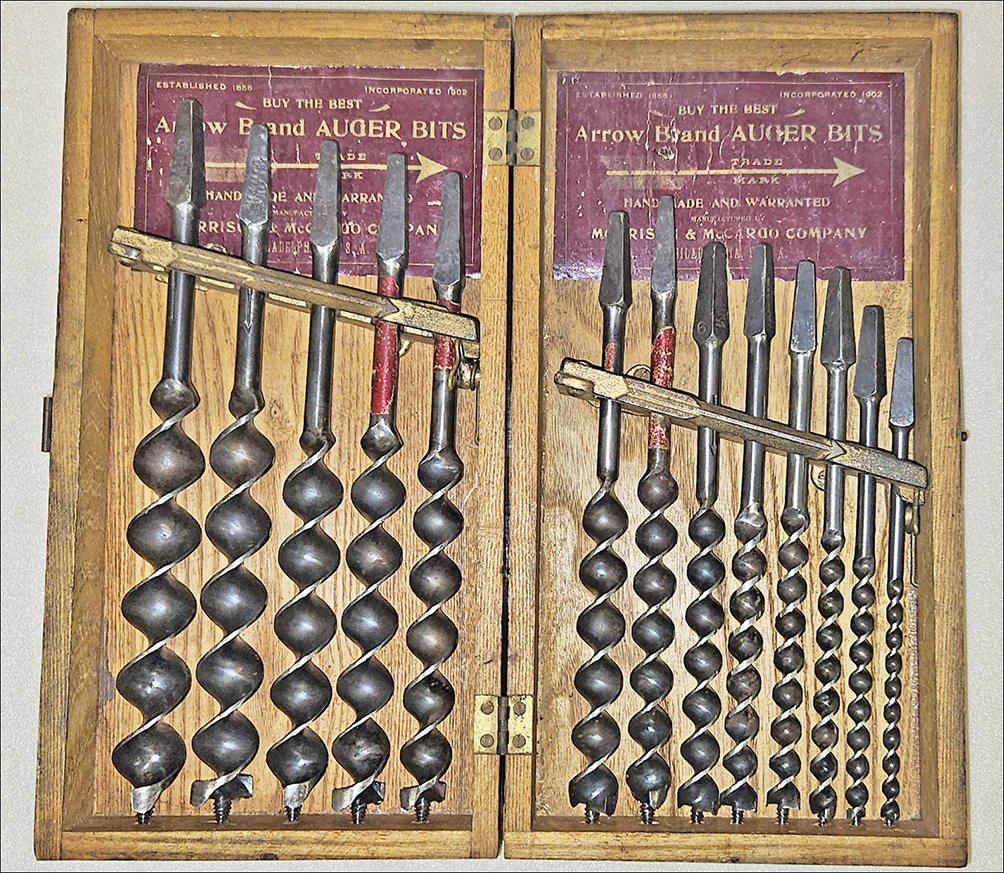
On December 8, 1902, Emerson E. McCargo (1858-1928), a steel supplier, joined with William T. Morrison to incorporate the Arrow brand business as Morrison, McCargo & Company. It was the second incorporation involving McCargo that year;; the previous month, he had incorporated his steel business as the McCargo Company.(4) Morrison, McCargo & Company continued to manufacture black-twist bits and package them in the traditional Arrow brand boxes. They manufactured them in Colwin, Pennsylvania and marked them M & M CO. PHILA PA. By 1913, the business had added axes and edge tools to its product line. The Alston Saw & Steel Co. of Folcroft, Pennsylvania, bought the company in 1918 and continued to market Arrow brand augers under the M & M name.(5) Though William Morrison died in 1919, the business retained the Morrison and McCargo names and made axes and edge tools in Darby until at least 1925.(6)
Illustration credit:
- Author's photos.
References:
- The 1866 start date for the Arrow brand's founding business can be found on the paper labels attached to the interior of Dewitt & Morrison bit boxes. A successor to Dewitt, Morrison & Kelley, it is unknown if the firm manufactured augers and bits from the outset.
- "Augers and Bits." Woodworkers Tools: being a Catalogue of Tools, Supplies, Machinery, and Similar Goods. Detroit, Michigan: Chas. A. Strelinger & Co., 1897. p. 688. Reprinted by The Midwest Tool Collectors Association, 1979.
- Welcome to Delaware County PA History. [Online Source]: delawarecountyhistory.com/darbyborough/DARBY_DIRECTORY_1897_A--Palmer051111.htm
- List of Corporations Enrolled in the Office of the Secretary of the Commonwealth During the Two Years Beginning June 1, 1901 and ending June 1, 1903.
- Pennsylvania Dept. of Labor and Industry Commerce. First Industrial Directory of Pennsylvania: 1913. Harrisburg, Pennsylvania: Bureau of Labor and Statistics, 1914. p. 139, 391.
- "Sale in the Auger Line." Hardware Dealers' Magazine. (July 1918). p. 156.
Bassett, David
The Great Patent Office Fire of 1836 destroyed the documentation for the March 18, 1829, screw-auger patent issued to forty-six-year-old blacksmith David Bassett of Derby, Connecticut. Though office staff found mention of the award in surviving lists of issued patents, Bassett failed to submit the original text and artwork—or certified copies—to the Office's project to re-create what was lost. The Patent
Office simply assigned a reference number (5043X) to be used in the event that the original documentation came to light. Fortunately, the Franklin Institute, a Philadelphia-based research institution, published a summary of the award in its journal shortly after its issue.(1) The patent covered the polishing of screw augers, and the summary reads:
This patent is taken for the manufacture, and not for the machinery employed. The ordinary screw auger is to be ground true, and polished throughout, by means of stones and buffs, in the way well known to workmen. The patentee thus states his claim.
What I claim as new in this invention, is the auger thus made by me, whether the brightening, smoothing, or polishing, be performed by the means aforesaid, or by any other means producing the same effect.
The advantages stated to result from polishing, are the lessened liability to corrosion, and the greater ease of working, from the facility with which the chip is delivered.
In 1831, David Bassett purchased the waterpower right on Beaver Brook, a small tributary of the Naugatuck River in an area of Derby now known as Ansonia. Shortly afterward, he built a dam and began making augers at the site.(2) Whether his augers were the brightly polished tools described in his 1829 patent remains a matter of speculation. The accumulated dirt and oxidation of nearly two centuries have done much to destroy the original surfaces of surviving examples. The tools he produced were stamped either D. BASSET or D. BASSETT.
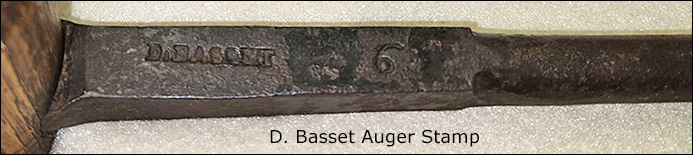
In 1836, David Bassett relocated to a raceway on the Housatonic River in an area of Derby known as Birmingham, where he associated with Eleazer Peck and expanded production.(3) Their thriving partnership is the likely source of augers marked D. BASSETT & CO. Peck left the operation in the mid-1840s, and Bassett brought his eldest son, Robert N. Bassett, into the business.(4) They stamped their output D. BASSETT & SON. Sometime before 1856, David Bassett retired from active participation in the enterprise, leaving the operation in the hands of his son Robert, who soon added galvanized pump chains to the product line. Though the factory continued to make augers for a time, their manufacture was soon de-emphasized. By 1859, the company's production had shifted to metallic wires for hoop skirts and steel parts for corsets.
David Bassett also sold coal, a logical sideline for someone operating a forge. His second son, Charles Lewis, worked in his father's auger shop for a time and later as a clerk in the family's coal business. Shortly before retiring from his auger business, David Bassett was appointed a deacon in his Congregational Church and was thereafter referred to as Deacon David Bassett. He died in 1872 at the age of eighty-three.
Illustration credit:
- D. Basset stamp: author's photo.
References:
- “American Patents: List of American Patents Granted in March 1829.” Journal of the Franklin Institute, new series, v. 3, 1829. p. 416.
- Samuel Cutter and Ambrose Beardsley. "Further Sketches" in: The History of the Old Town of Derby, Connecticut, 1642-1800. Springfield, Mass.: Springfield Printing Company, unnumbered page 825. Not all copies of the book have this page. The copy at the University of Virginia does.
- Rockey, J. L., ed. History of New Haven County. vol. 2. New York: W. W. Preston, 1892. p. 390.
- New-England Mercantile Union Business Directory ... New York: Pratt & Co., 1849. p. 285.
Bisbee, Daniel
Daniel Bisbee, Sr. (ca. 1774-1852) was one of the early augermakers in Kingston, Massachusetts, and likely apprenticed with the area's pioneering augermaker, Seth Washburn. Bisbee built a dam and set up shop on Trout Brook (originally Furnace Brook), a tributary of the Jones River, in 1810. The Kingston area had a rich history of ironworking going back at least to the mid-1700s, and the stream owed its original name to the presence of an early forge or blast furnace. Bisbee made augers at the site until 1844, when he sold out to Thomas Russell.(1)
Mentions of Bisbee's business are hard to find. He displayed his "screw augers" at the First Exhibition and Fair of the Massachusetts Charitable Mechanics Association in Boston in 1839.(2) The federal census of 1850 lists him as 74 years old (an error), still living in Kingston, and working as a "smithwright," an early term for a blacksmith. The same census lists his son, Daniel Jr., as a nailer—an early term for a nail maker.
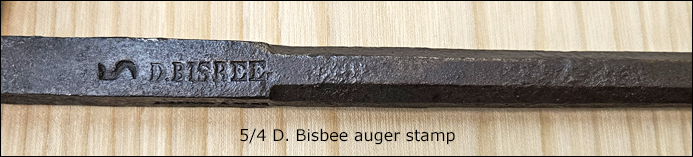
His augers are stamped D. BISBE or D. BISBEE.
References:
- Welker, Peter, et al., "Generations of Augermakers in Kingston, Massachusetts." Chronicle of the Early American Industries Association. v. 53, no. 3 (September 2000), p. 120.
- First Exhibition and Fair of the Massachusetts Charitable Mechanics Association. Boston: Dutton and Wentworth, 1837. p. 67.
Chester Mfg. Co.
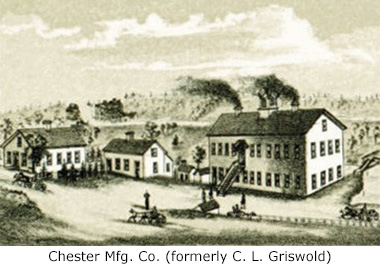
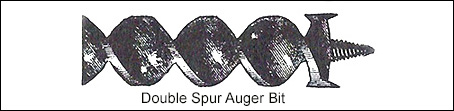
Located in the former C. L. Griswold factory on the south fork of Pattaconk Brook in Chester, Connecticut, the Chester Manufacturing Company was active between 1884 and 1919.(1) Most surviving auger bits are of the double-spur variety. A contemporary resource observes:
The first factory on the south stream is the bitt factory of C. L. Griswold, now occupied by the Chester Manufacturing Company, consisting of Edwin G. Smith, John H. Bailey, and Charles E. Wright, who manufacture auger bitts, corkscrews, reamers, etc. The factory is on the site of a forge built about the year 1816 and occupied by Abel Snow in the forging of ship anchors. About 1838, the building was used for the manufacture of carriage springs, later by C. L. Griswold & Co. for the manufacture of bitts, and by the present owners for the same business.(2)
By March of 1893, American augermakers were producing so many standard augers and bits that they had become a commodity. A soft economy only compounded the problem. A group of ten augermakers responded by forming the American Auger and Bit Association, an organization whose primary purpose was to set prices for various categories of augers, a practice sometimes referred to as price fixing. The Chester Mfg. Company became a charter member. Notable among the non-participants were the Irwin Auger Bit Company, whose unique designs were protected by patent, and the Russell Jennings Mfg. Company, whose bits commanded a premium. The organization remained active for some dozen years.(3)
The Chester Manufacturing Company ceased making bits in 1919.(4)
Illustration credit:
- Chester Manufacturing Company: View of Chester, Connecticut. [map] Boston: O. H. Bailey, 1881.
References:
- Nelson, Robert E., ed. Dictionary of American Toolmakers. Early American Industries Association, 1999. p. 164.
- Silliman, Samuel C. “Town of Chester,” in The History of Middlesex County, Connecticut: with Sketches of its Prominent Men. New York : J. H. Beers & Co., 1884. p. 222.
- "Augers and Bits." The Iron Age. (March 16, 1893). p. 635.
- Silliman, Kate. Kate Silliman's Chester Scrapbook. Chester, Connecticut: Chester Historical Society, 1986. p. 147.
Conard - Conrad
The Conard family manufactured augers and bits in Montgomery County, Pennsylvania, from ca. 1805 to 1904. The family patriarch, John Conard (1782-1853), apprenticed with ironmaster James Wood at Watson's Ford (today's Conshohocken). In 1805, he returned to his home in Whitpain Township and took up residence on an undeveloped part of what had been his father's farm. There, he cleared the land and built a house, barn, and log blacksmith shop.
John Conard is one of a half-dozen individuals credited with developing the "screw auger," though his relatively late appearance on the scene (ca. 1805) precludes the possibility.(1) Three of John Conard's sons became augermakers: Albert, Isaac, and Lewis. A fourth son, Joseph P., learned the trade in his father's shop but left it behind at age twenty to go into farming.(2)
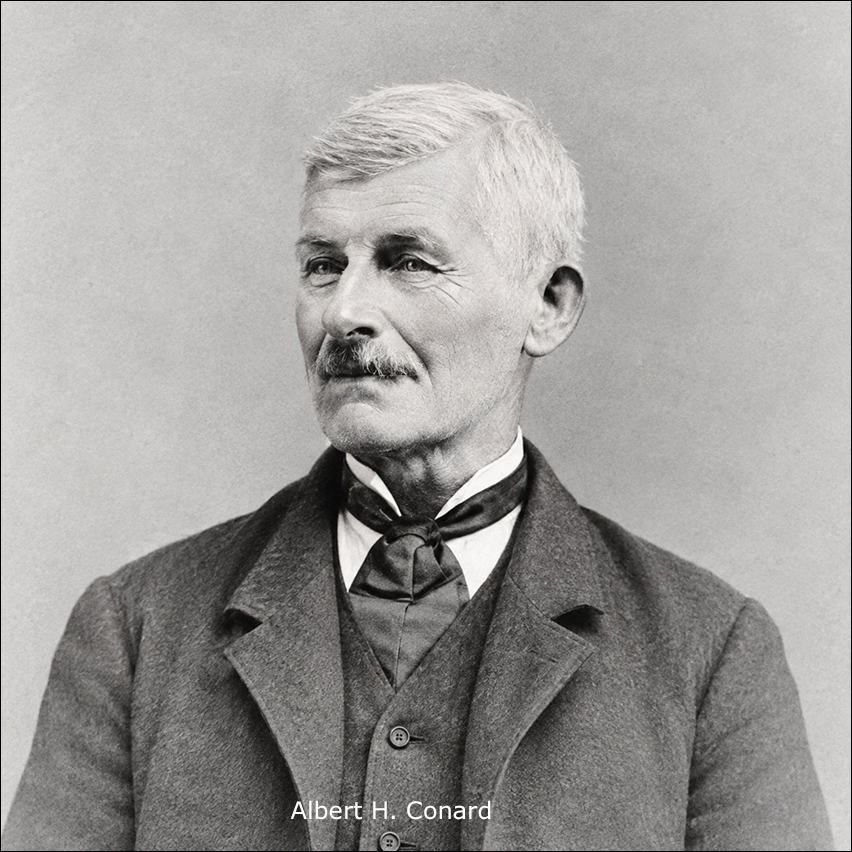
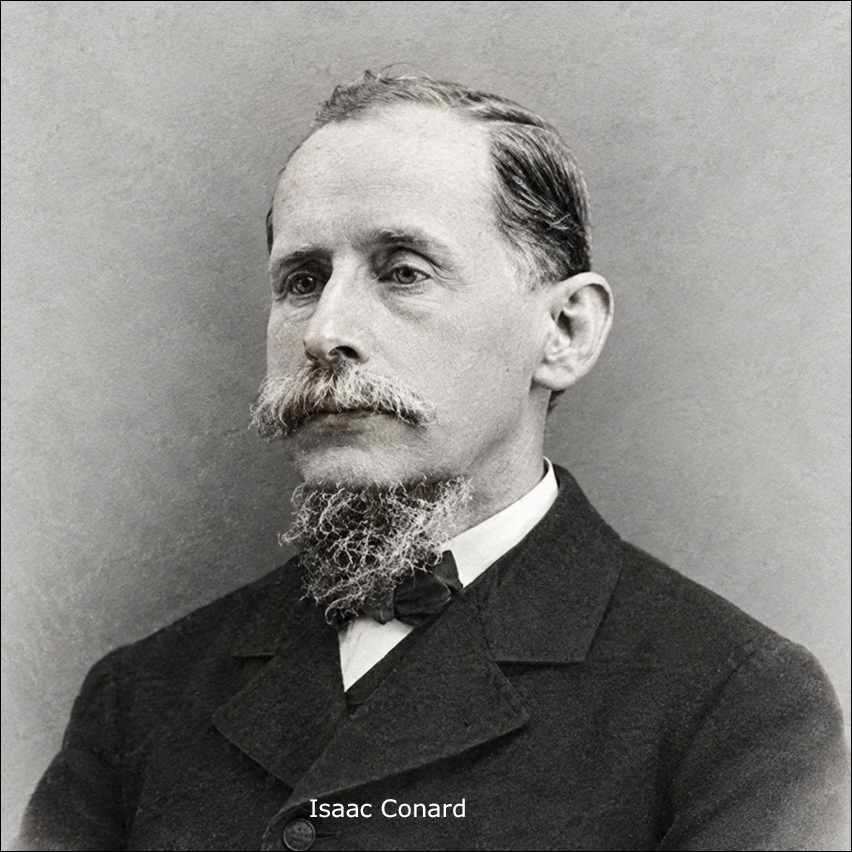
Albert H. Conard (1820–1904) learned the trade of augermaking from his father, John Conard (1782-1853). Albert later worked for several months at an auger shop in Exeter, Bucks County, until the business was sold in 1846. Sensing an opportunity, he purchased some of the operation's equipment and set up shop on Sandy Run in an existing mill.(3) The mill, powered by an undershot water wheel, was located a few miles from Fort Washington in nearby Whitemarsh Township, Montgomery County. His brother, Isaac Conard (1828-1911), began working with him that year, and in 1850, the operation's three employees produced 25,000 quarters of augers.(4) Anthropologist James Price explained the "quarter" system in a Facebook post:
A “quarter” was essentially the auger trade’s unit of size and value, not a unit of weight. An 8/4 auger contained eight quarter-inch size units because it was two inches in diameter. Manufacturers and wholesalers could total those quarter units across an assorted shipment and charge so much per quarter. The practice automatically made larger augers more expensive and roughly compensated for their greater material and manufacturing cost. Thus an advertisement for “5,000 quarters” describes a quantity of augers expressed in aggregate size units, rather than 5,000 pounds or 5,000 individual tools.(5)
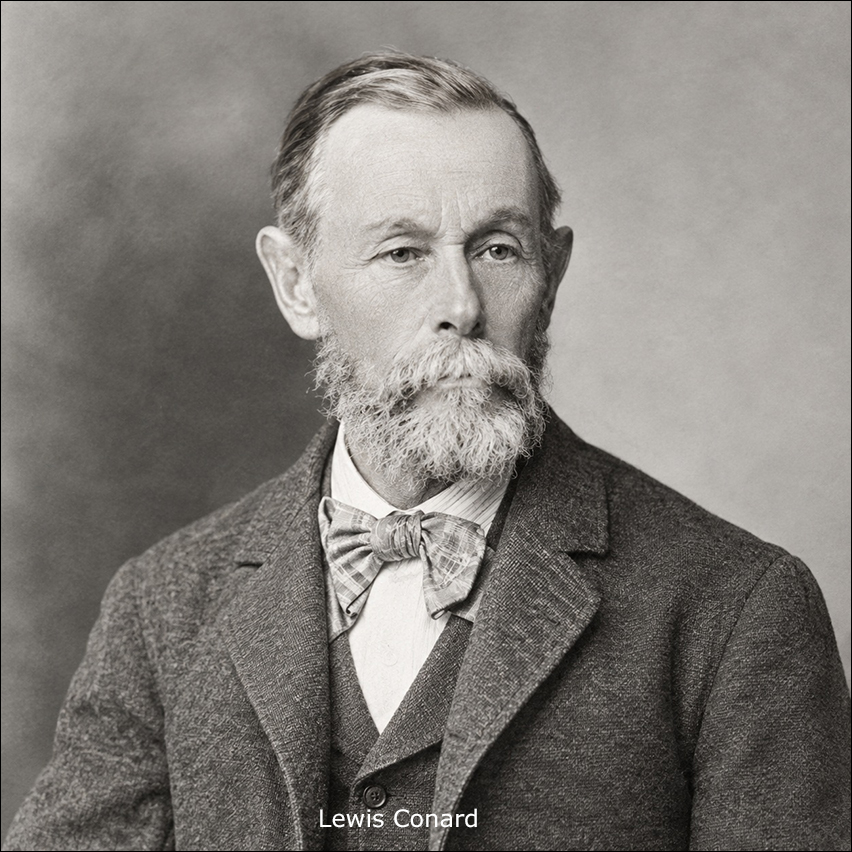
A decade later, Albert and Isaac Conard became partners in the firm A. & I. Conard. A third brother, Lewis Conard (1826-1911), worked for them for a time. Lewis, convinced that the traditional spelling of the family name was erroneous, changed his surname to Conrad.
In 1871, a hardware store placed an advertisement in the Lansdale Reporter offering customers discounts on both "Conard's and Conrad's screw augers and bitts."(5) Though Lewis Conrad became a schoolteacher in later life, the text of the ad suggests that, at some point, he may have operated an auger business independently of his brothers.
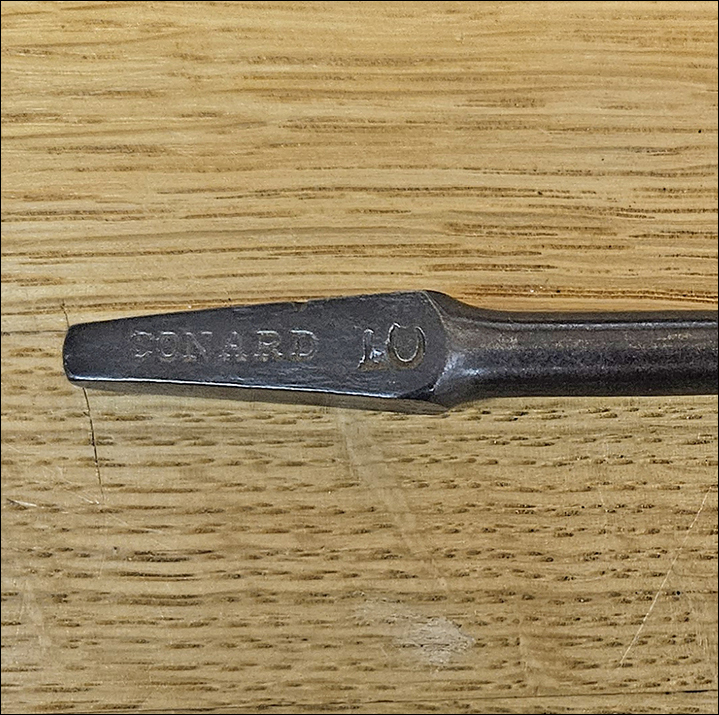
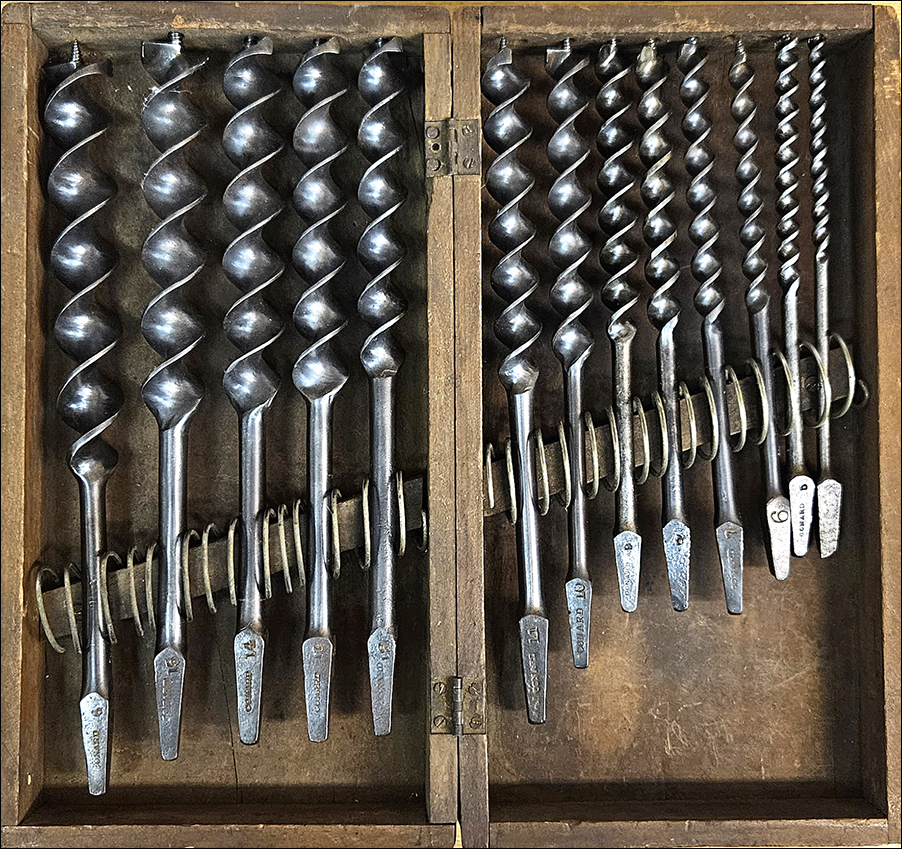
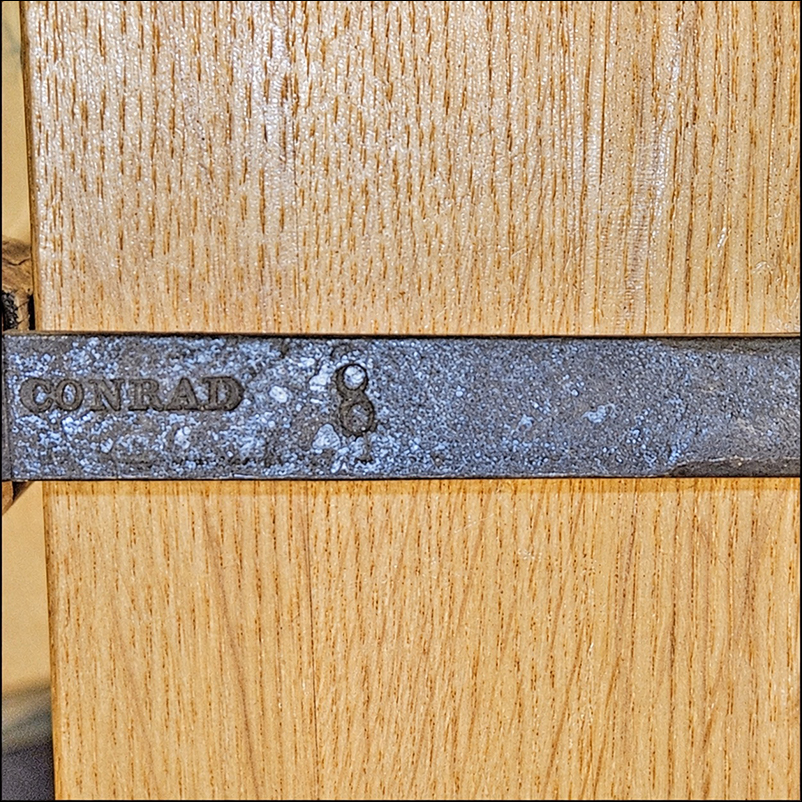
Albert Conard was at his forge making augers until the age of eighty-four. The Conard auger mill was sold the following year (1905). Most surviving examples of Conard family auger bits are of the double-spur variety. The earlier bits are typically stem-marked "A. & I. CONARD"; later bits are stamped on the tang with the single word CONARD. Like the family's Pennsylvania competitors Job T. Pugh and T. Slack, Conard auger bits are often found in coil-spring boxes. Though most larger-sized Conard double-twist wood augers are simply marked marked CONARD; examples marketed by Lewis Conard are marked "CONRAD," rather than Conard.
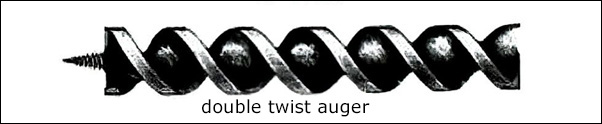
Illustration credits:
- Albert Conard portrait: Enhanced digital image, https://www.familysearch.org/en/tree/person/details/LWXS-S46
- Isaac Conard portrait: Enhanced digital image, https://www.familysearch.org/en/tree/person/details/KLY9-W98
- Lewis Conard portrait: Enhanced digital image, https://www.familysearch.org/en/tree/person/details/KLY9-7BB
- Augers and bits: author's photos
References:
- Bean, Theodore W., ed. History of Montgomery County, Pennsylvania. Philadelphia: Everts & Peck, 1884. p. 1142-1143, 1181.
- John and Sarah Childs Conard and their Descendants, Part 2. [s. l. : s. n.], 1939. http://conardfamilyhistory.com/part2.php (viewed 4/14/2023)
- "Death's Harvest: Albert Conard, of Fort Washington Expires." The Ambler Gazette (Lansdale, Pennsylvania). June 9, 1904. p. 4.
- United States Census Office. 1850 Census of Manufacturing, Montgomery County, Pennsylvania, Whitemarsh Township. Products of Industry Schedule. Digital image, https://www.familysearch.org/ark:/61903/3:1:3QHV-N3ZL-69ZL-P
- Price, James. Facebook post explaining the "quarter" system used in the auger trade. Vintage Drill Use, Collecting and Restoration Group, August 21. 2026. http://www.facebook.com/groups/460427374127502/?multi_permalinks=2978461165657431.
- "The North Wales Hardware, Iron and Stove Store." The Lansdale Reporter (Lansdale, Pennsylvania). June 22, 1871. p. 3.
Connecticut Valley Hardware Company
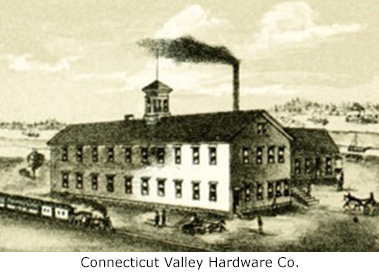
(Not to be confused with the Connecticut Valley Manufacturing Company)
The Connecticut Valley Hardware Company, a manufacturer of augers and bits, could trace its history back to its incorporation in 1871.(1) Its original location was likely the hamlet of Terryville, Connecticut, as a notice of its removal from there to the town of Chester appeared in an area newspaper in 1879.(2) The Chester/Deep River area had been a center for auger production since the renowned L'Hommedieu brothers set up shop on there in 1812. Though the brothers were no longer in business, the Deep River Mfg. Company, C. & D. Canfield, A. H. & J. Deuse, Charles L. Griswold, the Chester Manufacturing Company, George G. Griswold & Co., and S. C. Silliman & Company carried on the tradition, taking advantage of the town's skilled craftsmen to continue the manufacture of augers and bits.
At Chester, Connecticut Valley Hardware set up shop in a two-story wooden building measuring 110 x 38 feet. The structure was not new; it had been built in 1873 for the manufacture of wire bed frames. The company powered its operation by steam and employed some 45 workers. R. J. Allyn, proprietor of Hartford's prestigious Allyn House Hotel, served as the company president, and George F. Stearns as plant superintendent and secretary of the board. Double-spur bits made up the bulk of the company's production.
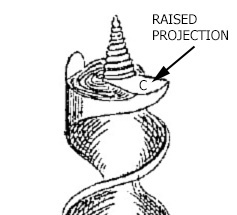
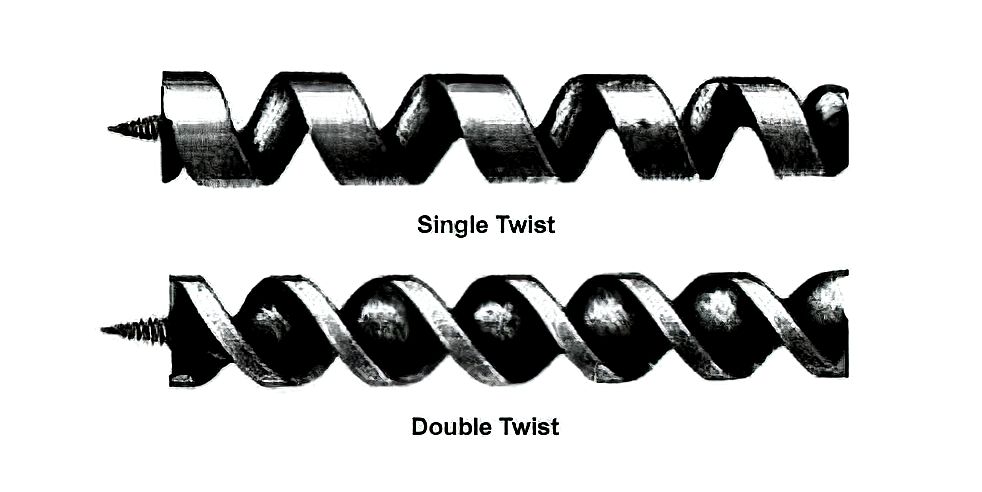
The Connecticut Valley Hardware Company went on to acquire the rights to a double-twist auger patented by Chester native Ira Payne in 1868. Payne designed his bit with one of the two channels filled in order to strengthen the head and provide a surface to accommodate a replaceable spur. His design included a raised "projection" on its single cutting lip to ease sharpening by reducing the amount of steel to be removed. For reasons unknown, Payne claimed only the raised projection as the innovative feature of his bit when he filed his patent claim. The final sentence of the document reads:
What I claim as my invention and, desire to secure by Letters Patent is — the projection C on the floor–lip, for the purposes set forth.(3)
Payne's failure to draw attention to the most obvious feature of his bit, its reinforced cutting head, remains a mystery. He remedied the omission by seeking to have his patent reissued so as to correct errors in the text and drawings of the original claim. The Patent Office granted his request on March 15, 1870. The reissue document neither depicts nor mentions the raised projection that formed the basis for Payne's original claim but speaks instead to "a double-twist bit or auger having a head made solid on one side."(4)
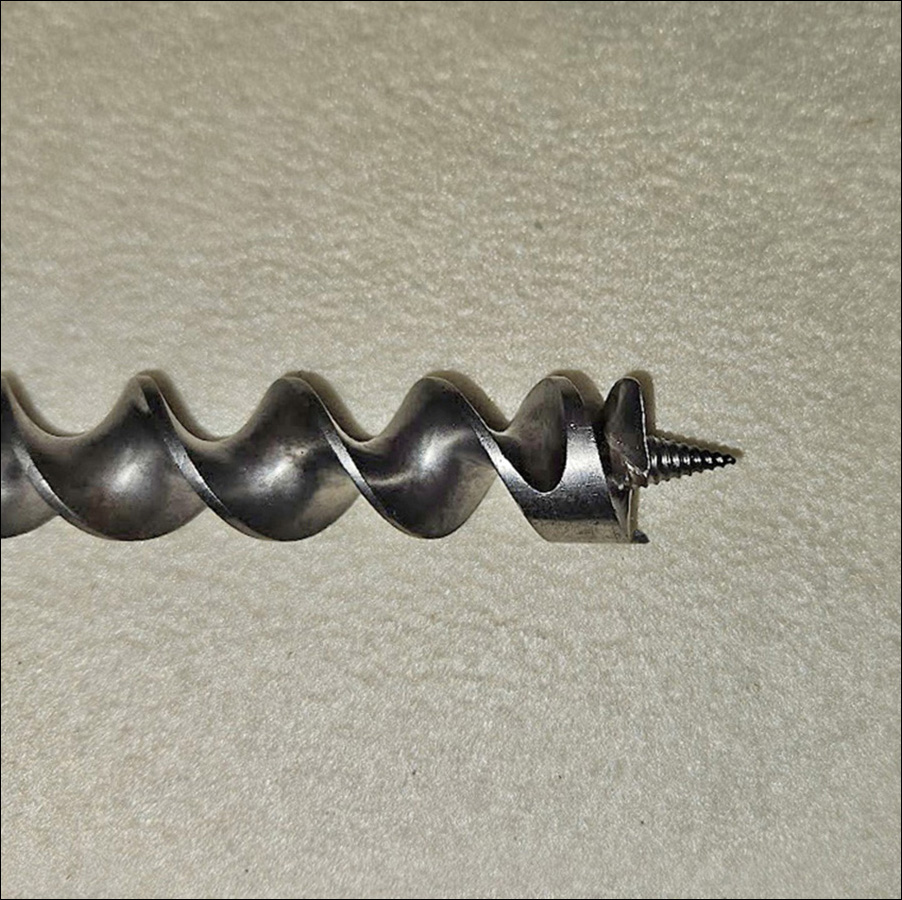
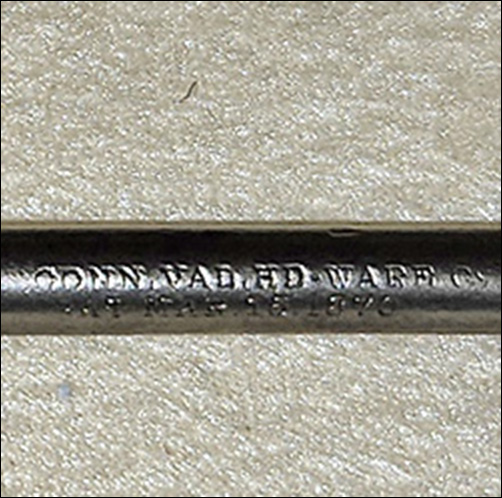
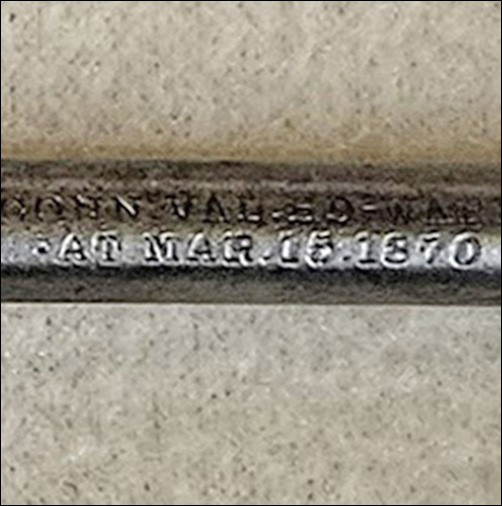
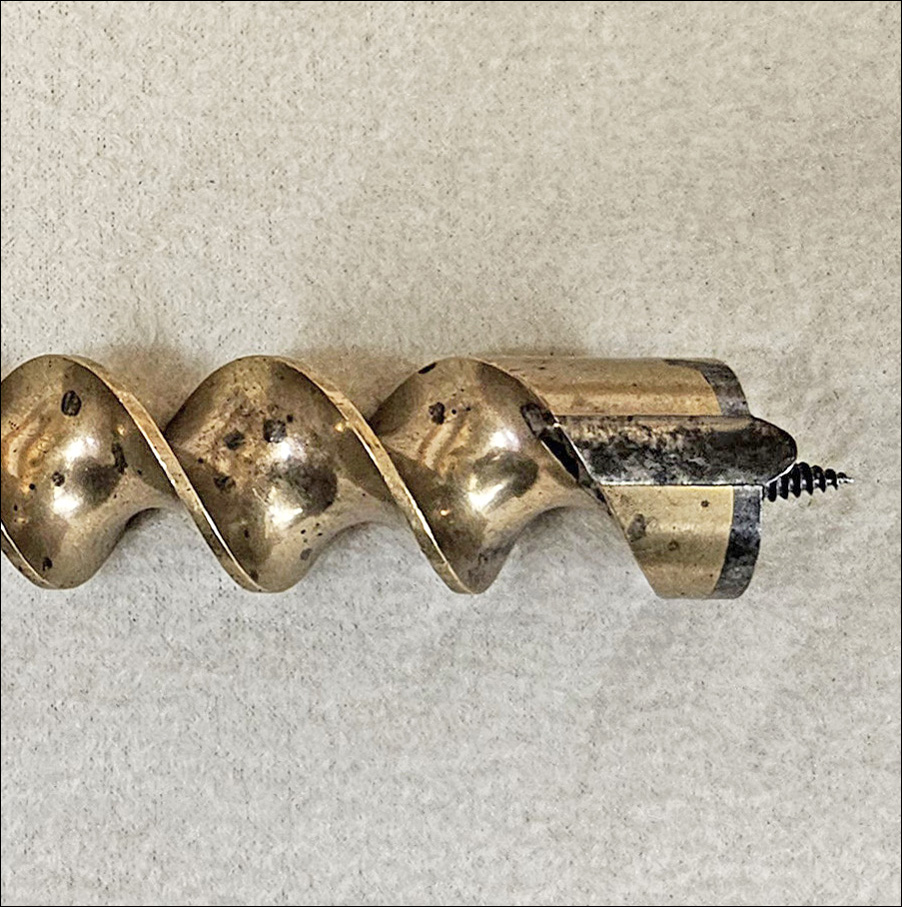
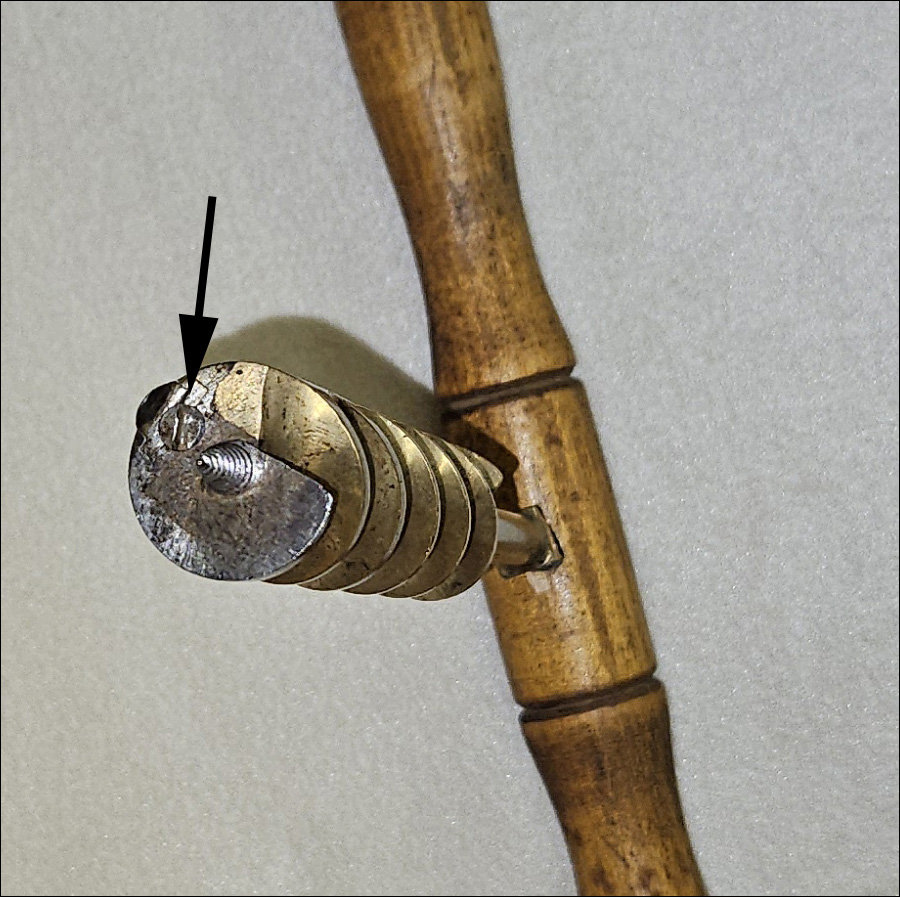
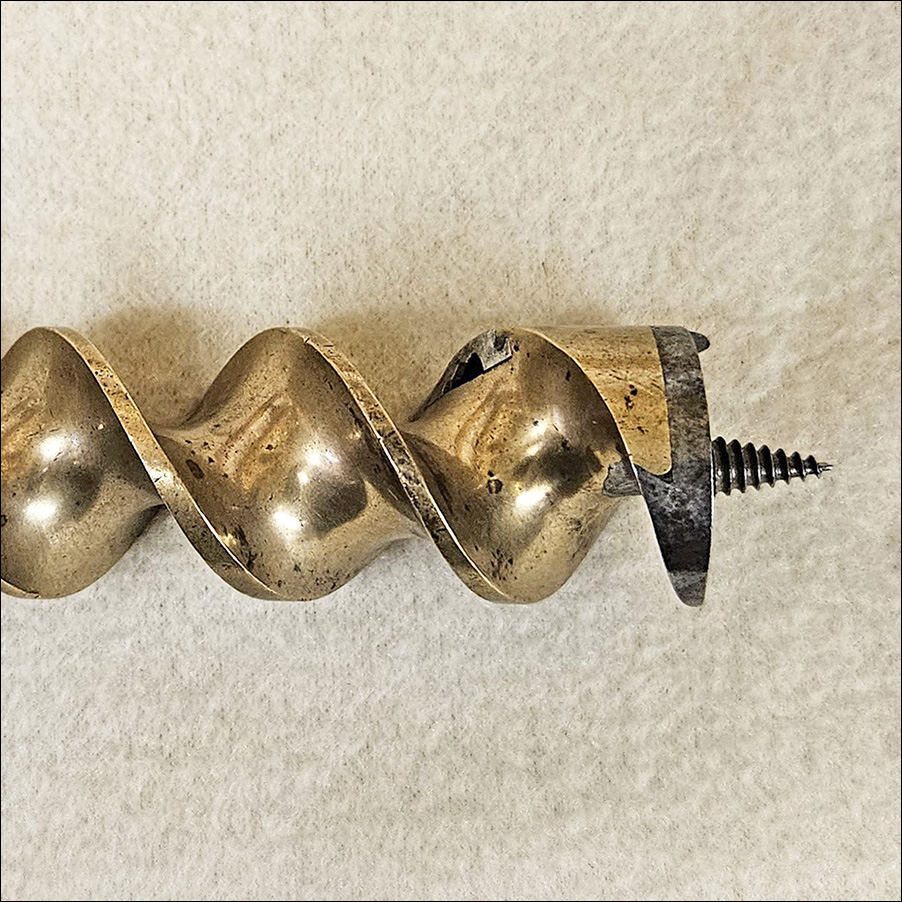
Superintendent George Stearns revisited Ira Payne's ten-year-old design in 1878. Payne's original patent application had mentioned the possibility of mounting a replacement spur to a cut in his bit's reinforced head should the original be broken. Other than a passing reference to a dovetailed slot for housing the new spur, he included no details for attaching it to the bit, nor did he claim it as a patentable feature. Stearns worked to turn Payne's vision into a reality, and on June 25, 1878, was awarded a patent for his efforts. Stearns went a step further than Payne. He made his spur adjustable.
The object of my invention is to provide a cutting-lip (i. e. a spur) which can be readily adjustable by means of a screw, and can easily be removed for the purpose of sharpening.(5)
Although Stearns assigned half the rights to his invention to company president R. J. Allyn, it is unlikely the complicated bit ever made it into production. The tool would have been difficult to manufacture, and consumers would have balked at the extra cost. Two bronze versions of the bit are known and were likely created as proof-of-concept.
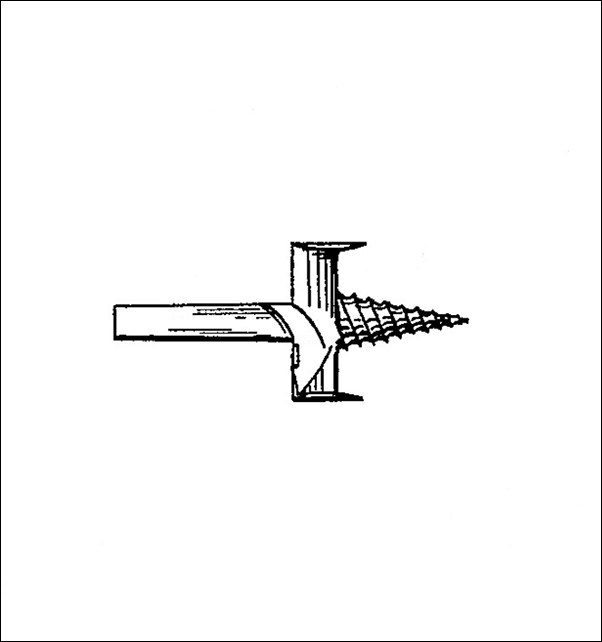
In 1885, Henry S. Lord, a Civil War veteran and former employee of the Allyn House Hotel, patented an auger and assigned the rights to its owner, R. J. Allyn.(6) Lord's bit, with a replaceable lead screw, represented a logical extension of the thinking of Thomas Wood and James Morris, residents of Birmingham, Connecticut, who patented a malleable iron auger with a replaceable steel head in 1882.(7) Henry Lord's patent provided for a steel head with a threaded central hole that allowed for lead screw replacement. Like Stearns's design, Lord’s bit appears never to have entered production, and no further Lord–Allyn collaborations are known.
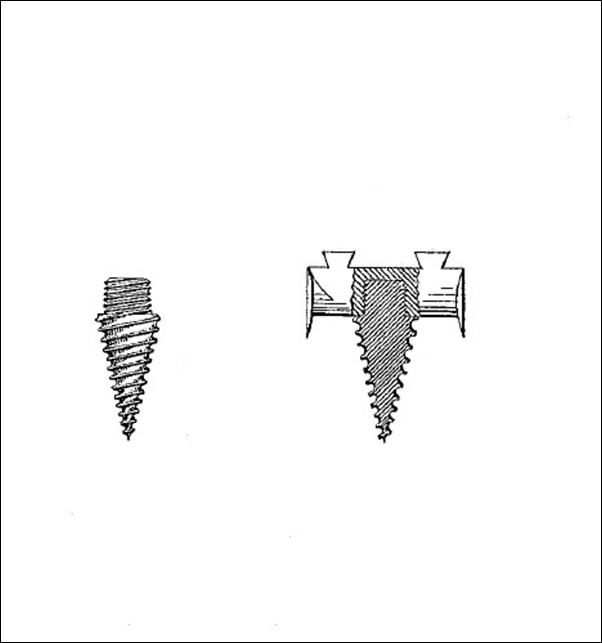
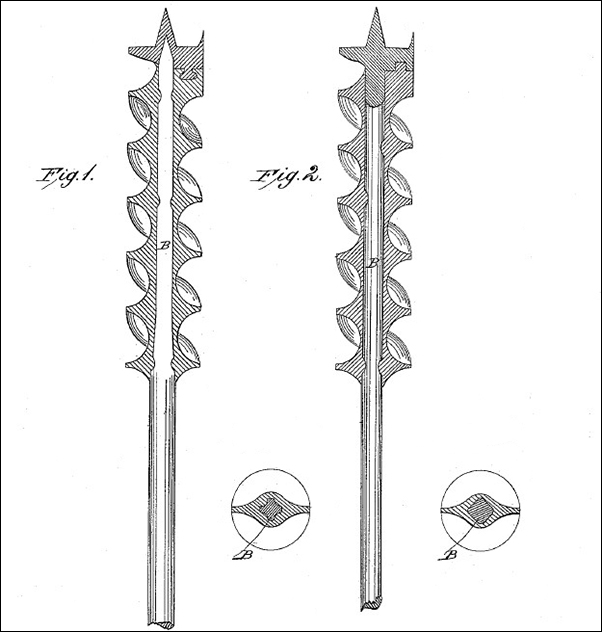
On December 12th of the same year, Stearns patented a method of making augers with a central core, an arrangement he considered superior to the standard product.(8) The core, an extension of the auger's stem, was to be manufactured of steel or high-quality iron, and the worm cast around it. The core was intended to provide the extra strength needed to protect the twisted part of the bit from breaking. Though Stearns sold a half-interest in the patent to company president R. J. Allyn, evidence for the manufacture of the bit has yet to surface, and advantages in metallurgy would soon render the auger's complicated construction obsolete.
On January 18th, 1887, George F. Stearns patented an "apparatus for making molds for twisted articles."(9) Obviously intended for creating dies for augers, the language of the patent was general enough to encompass molds for other items with a regular twist or repetitive convolutions. Once again, he assigned a half-interest to Allyn. It would be their last collaboration. Allyn died the following year (1888), and the Connecticut Valley Hardware Company folded in 1890. After the closure, Stearns went on to become the postmaster at Chester.
Illustration credits:
- Line drawings in this article are taken from digital versions of the original patents.
- Connecticut Valley Hardware Company factory: View of Chester, Connecticut. [map] Boston: O. H. Bailey, 1881.
- Ira Payne bit: author's photos.
- Bronze Stearns bit: author's photos.
References:
- The Historical, Statistical and Industrial Review of the State of Connecticut. Part II. New York: W. S. Webb & Company, 1884. p. 284.
- "Middlesex." Hartford Courant (Hartford, Connecticut), February 8, 1879. p. 4.
- United States Letters Patent No. 75,454,(March 10, 1868)
- United States Letters Patent Reissue No. 3,879, March 15, 1870).
- United States Letters Patent No. 205,218, (June 25, 1878).
- United States Letters Patent No. 329,660, (November 3, 1885).
- United States Letters Patent No. 254,184, (February 28, 1882).
- United States Letters Patent No. 333,170, (December 29, 1885).
- United States Letters Patent No. 356,430, (January 18, 1887).
Conrad see Conard
Cook see Ransom Cook
D. & M. (Dewitt & Morrison) see Arrow brand
D. M. & K. (Dewitt, Morrison & Kelley) see Arrow brand
Deuse
Three generations of the Deuse family made auger bits, gimlets, screwdrivers, punches, and other small tools on the north branch of Pattaconk Brook in Chester, Connecticut, between 1867 and 1966. The original firm, S. Deuse & Brother, was founded by Simeon and Amos H. Deuse in 1867. When Simeon left Chester for Hartford in 1872, Amos bought the land and waterpower privilege. A third brother, James Smith Deuse, bought into the operation, and in 1880 the business became A. H. & J. S. Deuse.(1)
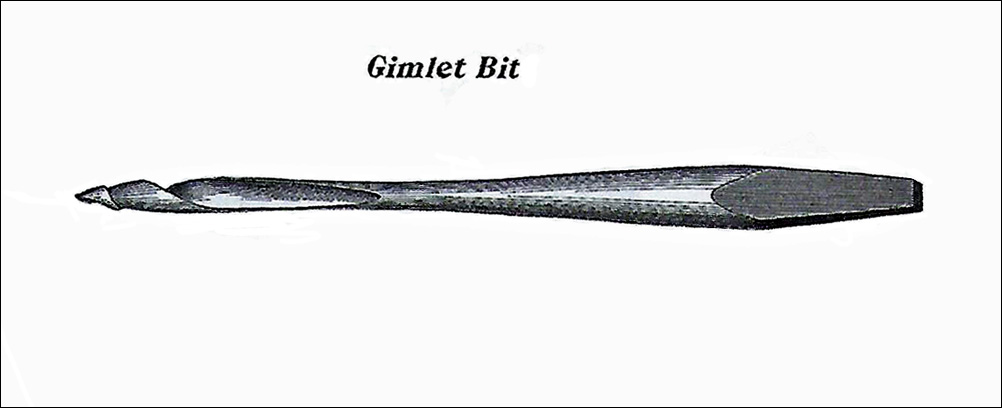
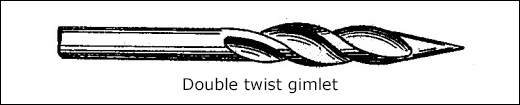
The same year, Amos and James Deuse were issued United States Letters Patent No. 224,156 for a die to manufacture double-twist gimlets. Few, if any, of the Deuse operation's gimlets were stamped with a manufacturer identification. A marked example of a Deuse double-twist gimlet has yet to turn up.
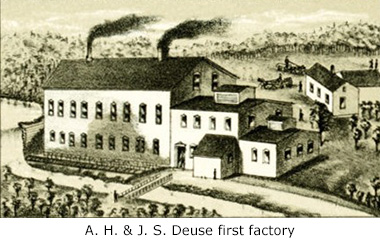
The brothers' factory burned to the ground on April 28, 1898. Deep Hollow, the site of the structure, was somewhat isolated, so no one discovered the fire until the next morning, when workmen arrived and found the structure reduced to ashes. The office and packing room survived the fire, but Amos Deuse withdrew from the partnership, leaving James S. Deuse as sole proprietor of the business. Unwilling to let the business go, James Deuse built a 30 x 90-foot two-story replacement factory, a structure attached it to the older buildings, and coninued producitng gimlets and augers.
To all appearances, James Smith Deuse was a respectable man, serving as a representative to the Connecticut General Assembly for the 1897-98 session and as president of the Chester Savings Bank from 1916 to 1928. His life, however, was not without scandal. Earlier, in 1894, he had been charged with an assault on Mrs. Ellen Dickenson at a family gathering.
The claim is that when Mrs. Dickenson entered the house some of the men present were having a quarrel and that Mr. Deuse struck her on the back and seizing her by the neck and arm, pushed her out of doors. Charles B. Davis testified to seeing Deuse strike Mrs. Dickenson and said it caused a swelling on her shoulder as large as a saucer. Two daughters testified to dressing the wound. The defense claimed no blows were given and that Deuse placed his hand on her shoulder, turned her around, and told her to leave.(2)
Though the outcome of the trial is unknown, the scandal was nothing compared to the fuss his son's marital problems created in 1900. Burton Deuse worked for his father as plant superintendent and bookkeeper. A married man, Burton unexpectedly ran off with his wife's sister, a lass of eighteen, leaving his spouse, toddler son, and infant daughter behind. The couple fled to Galveston, Texas, and then to New York. Sadly, a lifetime of undying love was not in their future. The young lady returned home five weeks later, a sadder, but wiser woman.(3) An unpopular Burton Deuse did not return to Chester but remained in New York City. Burton's brother Edison became increasingly involved in the operation of the company factory, and when James Smith Deuse passed away in 1937, the firm became the E. W. Deuse Company. The business folded in 1966.
Illustration credits:
- double-twist gimlet bit: United States Letters Patent No. 224,156, (February 3, 1880).
- Deuse first factory: View of Chester Connecticut. [map] Boston: O. H. Bailey, 1881.
References:
- Silliman, Kate. Kate Silliman's Chester Scrapbook. Chester, Connecticut: Chester Historical Society, 1986. p. 143.
- "Middletown." Hartford Courant (Hartford, Connecticut). April 5, 1894. p. 8.
- "Sensation in Chester." Hartford Courant (Hartford, Connecticut), June 22, 1900. p. 1; "Stella Morse Returns." Hartford Courant (Hartford, Connecticut), July 24, 1900. p. 3.
Dwight, Timothy
Two Timothy Dwights, a father and son, manufactured augers in Humphreysville (Seymour) in the early 19th century. The elder Timothy Dwight built a factory at the mouth of the Little River and began making augers there. By October of 1834, his son Timothy Dwight, Jr. had joined him, and the men's augers had won a "diploma" at the Fair of the American Institute of New York City.(1) They stamped their augers T. DWIGHT & SON.
Timothy Dwight, Sr., passed away in 1844. At the time, Timothy Dwight, Jr., was no longer part of his father's business. Seven years earlier, in 1837, the younger Dwight had built a shop at the mouth of the Little River, a tributary of the Naugatuck, on the bank opposite Blueville. His business, T. DWIGHT JR. & COMPANY, manufactured augers, chisels, and plane irons. His augers won a silver medal at the 1839 fair of the American Institute of New York City.(2) His enterprise was listed in Price & Lee's New Haven Directory as late as 1842.
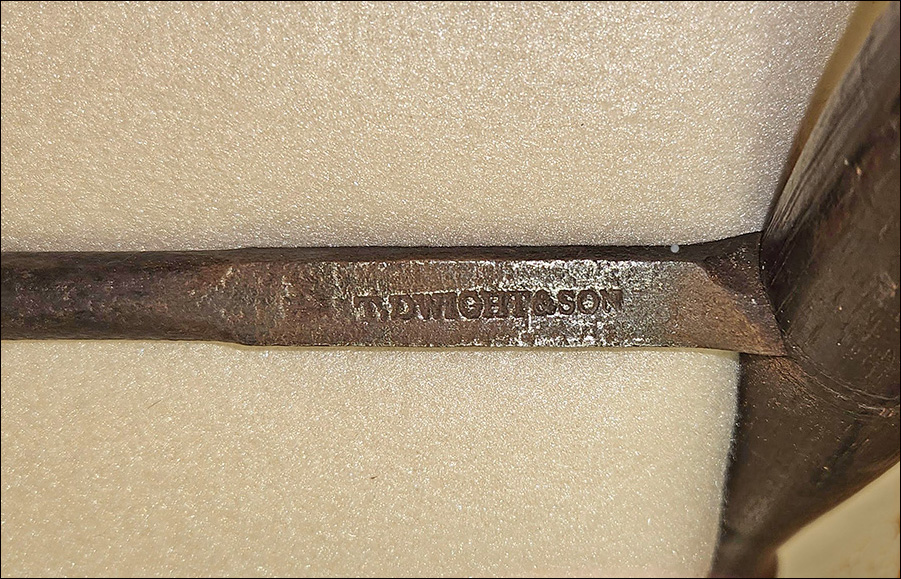
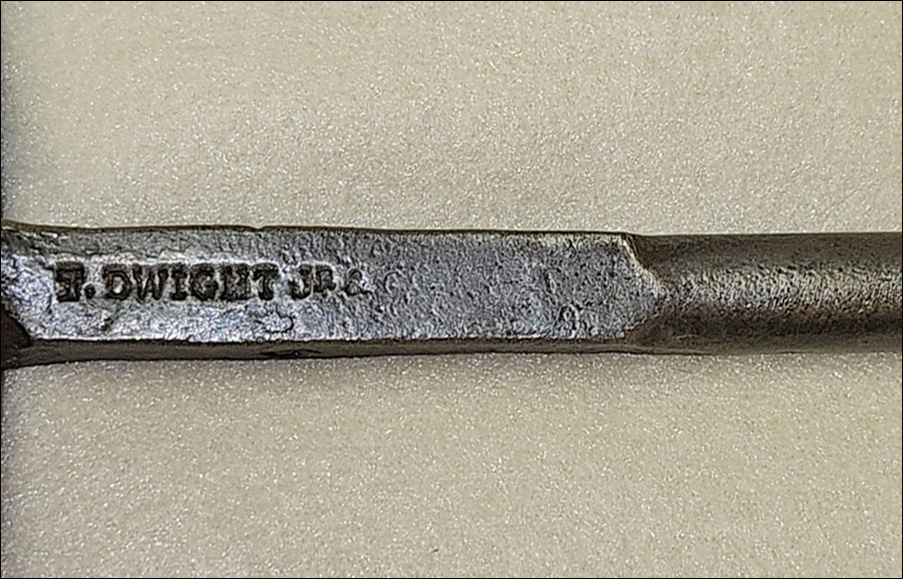
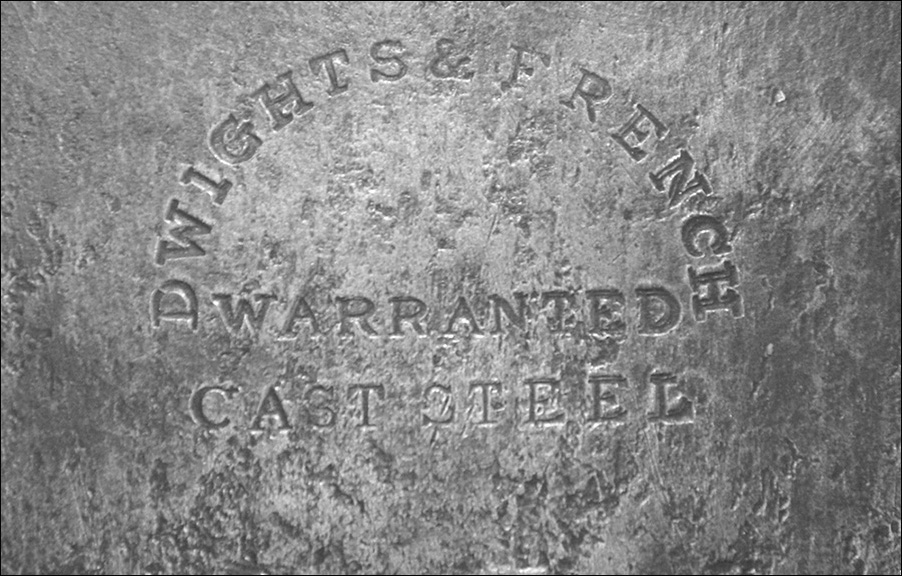
What relation Timothy Dwight, Jr., might have had with the Seymour-based Dwights & Foster, makers of edge tools, is uncertain. The firm was short-lived and appears to have been active in the mid-1840s. Since Timothy Dwight, Sr., lived until 1844 and his son William J. was also involved in the auger/edge tool business, any of the three may have been connected to the operation. It has been suggested that hand plane inventor William Foster of Washington, D. C., served as a principal in the business, but at this point, the matter remains speculative.(3)
In 1845, Timothy Dwight partnered with Raymond French to form Dwight & French, a manufacturer of augers and edge tools. They set up shop in a wood-frame factory using the waterpower of the Rimmon Falls (Tingue) dam and stamped their wares either DWIGHT & FRENCH, or DWIGHT FRENCH & CO. When fire destroyed the factory in 1849, the owners replaced it with a new brick structure. At about this time, William J. Dwight, the younger brother of Timothy Dwight, Jr., made a substantial investment in the operation, and as a result, the business became Dwights, French & Company. Its products were marked either DWIGHTS & FRENCH, or DWIGHTS FRENCH & CO.
After the fire, Dwights French & Company began making railroad cars, perhaps influenced by Charles French, Raymond's son, who had developed a wildly successful car spring. The company reorganized and split into two parts in 1852: the American Car Company, which focused on the railway side of the business, and a reorganized Humphreysville Manufacturing Company, which made tools.(4) Raymond French, Timothy Dwight, and John W. Dwight became major shareholders. When the Board of Directors moved the car works west to Chicago in 1855, the Humphreysville Manufacturing Company assumed control of its Seymour assets. Dwight and his brother John went on to become major stockholders in the New Haven Copper Company, an entity that included augers and bits among its products. Timothy Dwight eventually moved to the Chicago area where he worked in the railroad car business, and later in the manufacture and sale of paper.(5) He passed away in New Haven, Connecticut, in 1895.
Illustration credit:- Author's photos
- "Seventh Annual Fair of the American Institute, held at Nielo's Gardens, October, 1834." Mechanics' Magazine and Register of Inventions and Improvements. v. 4, no. 4, p. (October, 1834), p. 249.
- "Premiums Awarded at the Twelfth Annual Fair of the American Institute..." Journal of the American Institute. Vol. 4, No. 12, p. (September, 1839), p. 668.
- Smith, Roger K. Patented Transitional and Metallic Planes in America. Vol. 2. Athol, Massachusetts: self published, 1992, p. 12.
- Rockey, J. L., ed. History of New Haven County. vol. 2. New York: W. W. Preston, 1892. p. 601.
- Dwight, Benjamin W. The History of the Descendants of John Dwight, of Dedham, Mass. Vol. 1. New York: John F. Trow & Son, 1874. p. 171.
Eddy - G. W. Eddy & Company
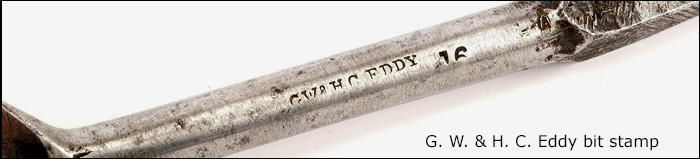
G. W. Eddy & Company manufactured augers on the Champlain Canal a short distance from Waterford, New York. The firm was operated by prominent local industrialist George Washington Eddy, founder of the noted Mohawk and Hudson Foundry, a larger operation located a mile and a half from the Champlain site. Little is known about the auger side of his operations, save that the Champlain Canal works were destroyed by a devastating fire on December 27, 1861.(1) Although they almost certainly exist, augers bearing the specific "G. W. Eddy & Company" mark have yet to surface. However, extant double-spur auger bits stamped G. W. & H. C. EDDY—representing George and his son, Harvey C. Eddy—are known.
Illustration Credit:
- G. W. & H. C. Eddy bit stamp: S.J. Islander
Reference:
- "Fires." Hartford Daily Courant (Hartford, Connecticut) Dec. 31, 1861. p. 3.
Essex Manufacturing Company
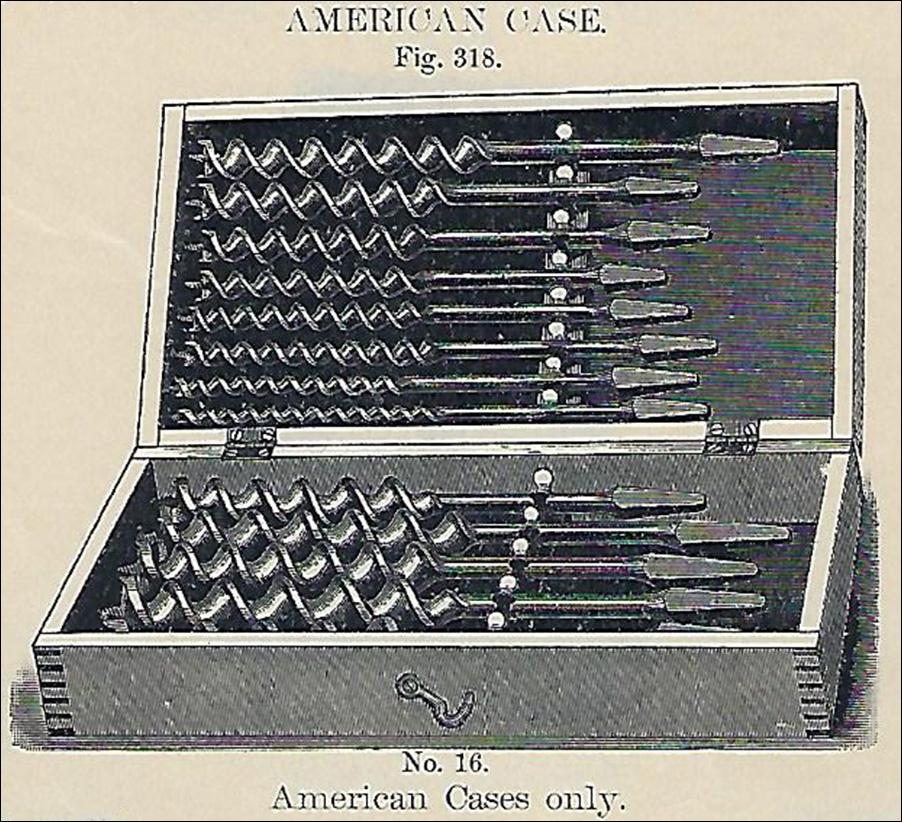
Catalogs of Sargent & Company of New Haven, Connecticut, indicate the business sold auger bits stamped Essex Mfg. Co. in 1910 and 1911. Sets of bits are often found in wooden American Case boxes. Several firms bore the name Essex Manufacturing Company in the late 19th and early 20th century United States. A likely candidate for auger production has yet to be identified.
French, Raymond
Note: Raymond French was not closely related to fellow Seymour augermaker Walter French.
Raymond French was nine years old at the time of his father's untimely death in 1814. At an early age, he was apprenticed to local blacksmith Isaac Kinney.(1) He may have been twelve to thirteen years old at the time, a typical age for binding a lad to his master. The death of his father raises the possibility that he may have been as young as ten.
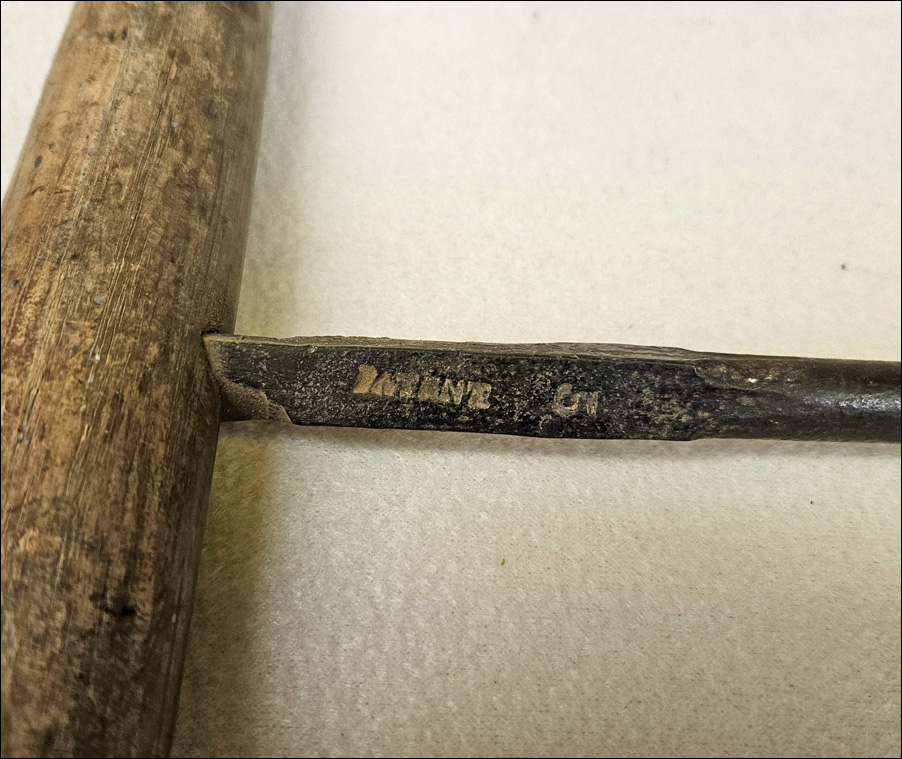
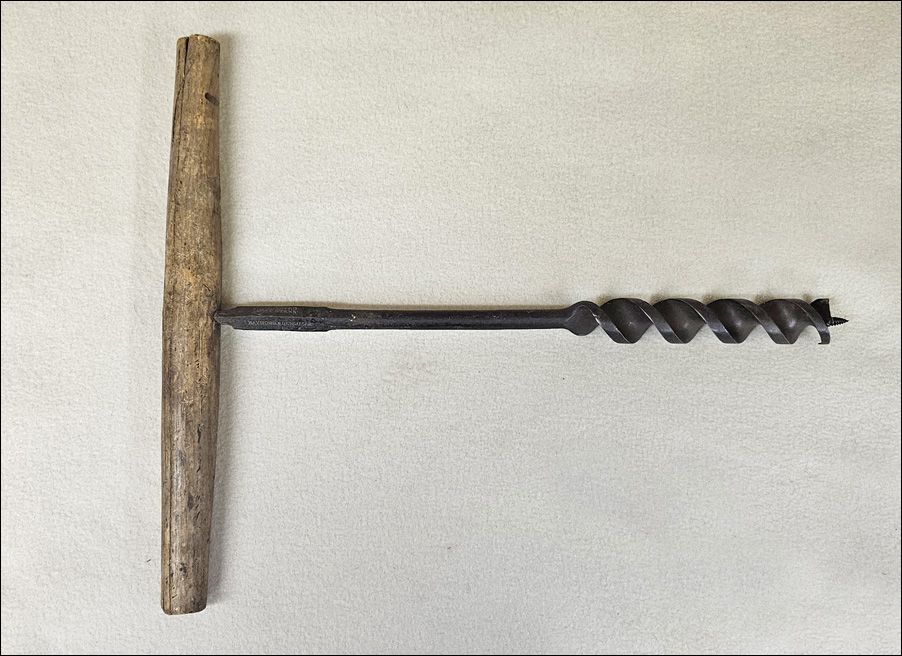
At the end of his apprenticeship, Raymond French went to work in a nearby auger shop where he developed a reputation as a proficient toolmaker. In 1828, at the age of twenty-six, he left Seymour and moved to the Caribbean island of Trinidad, where he worked for the British government installing and maintaining machinery for processing sugar cane. He returned in 1834 and partnered with John C. Wheeler in an augermaking enterprise on Bladen's Brook in a neighborhood then known as Blueville. That year, he was awarded the first of his two auger-related patents.(2) A summary of the 1834 patent in the Journal of the Franklin Institute notes:
This is said to be an improvement on screw, pump, and spur augers, and consists in giving to the plates which are to be twisted, a longitudinal, concave surface, so that the plate, as well as the pod, when twisted, shall be thinner at the centre than at the edges. ... The advantage derived from this construction is said to be, that it gives to the spiral cavities of the pod, when twisted, a greater capacity towards the inner surface, and more perfectly envelopes the core, or chips, within a metallic surface, in their passage from the bottom to the top of the hole while boring, by which they are caused to rise and flow off more freely and rapidly.(3)
Raymond French became sole owner of the business in 1837. Two years later, he and Hiram Upson bought two parcels of real estate from John C. Wheeler, French’s former partner. The property included a machine shop built by Newell Johnson in 1832, where the men began manufacturing augers.(4) Their partnership is the source of the rarely seen augers stamped FRENCH & UPSON. When fire destroyed the shop on July 1, 1841, work on a replacement began almost immediately. The disaster may have had something to do with Upson leaving the business and Raymond French's decision to associate with Timothy Dwight, Jr. Timothy Dwight was no stranger to augermaking. In 1837, he had built a shop at the mouth of the Little River, a tributary of the Naugatuck, on the bank opposite Blueville.
In 1843, Raymond French patented a double-twist auger having a single cutting lip with one hollow deeper than the other. The deeper hollow was connected to the cutting lip. It is not known if the auger made it into production. According to French:
The superiority of this auger thus made consists in this, that it is stronger, less liable to spring or bend, and more durable than the single-twist auger, and also in boring more rapidly, and making a straighter hole, than the common double-twist.(5)
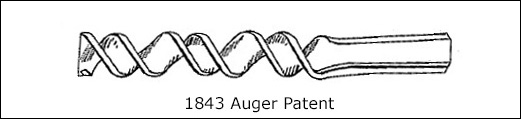
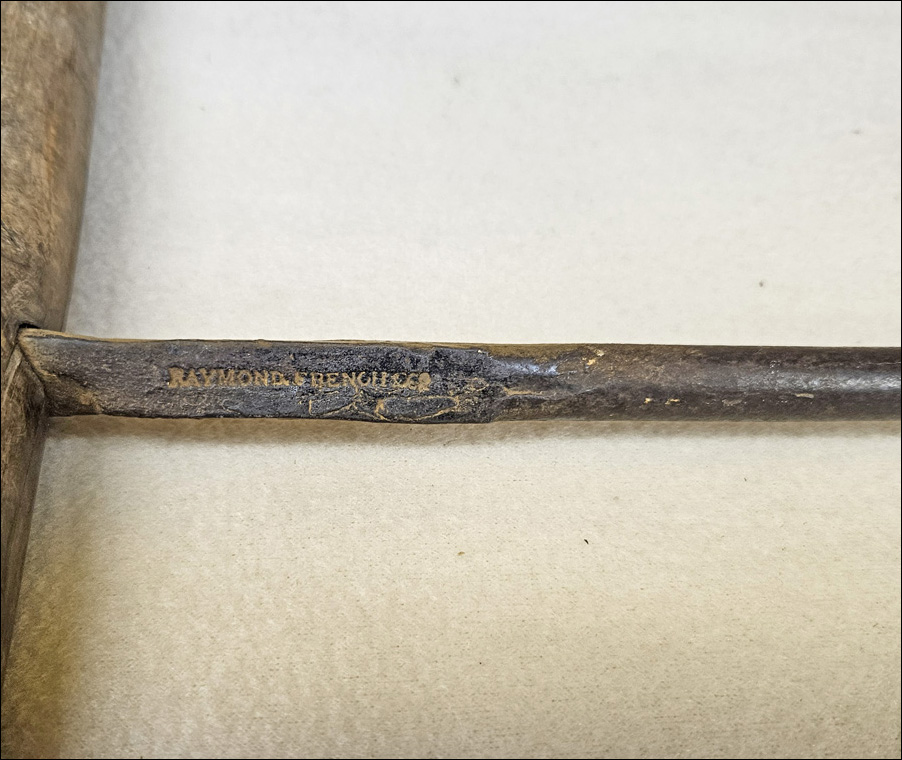
The initial name for the French/Dwight collaboration was Raymond French & Company. The operation stamped its augers RAYMOND FRENCH & CO. The business did so well that the principals were soon looking to expand. Needing extra space, they installed machinery in a second shop at the mouth of the Little River while Raymond French scouted a location for a new dam near Kinneytown, a few miles downstream from Seymour. Securing the property he needed, French went to work on the dam immediately. Unfortunately, he began construction before he had a firm title to all the land needed to maintain exclusive rights to the water power. Though he prevailed in the end, Raymond French sold the completed dam that same year (1844) without moving Raymond French & Company to the site.
When Raymond French & Company reorganized to become DWIGHT & FRENCH in 1845, the operation sold its Blueville shop and bought a parcel of land and a portion of the power generated by the Rimmon Falls (Tingue) dam. They purchased these from the Humphreysville Manufacturing Company, a cloth and paper manufacturer established in 1831. The partners initially set up shop in a wooden-frame building on a canal created by the Tingue Dam. A fire destroyed the shop in 1849, and the company built a "large brick mill and fitted it up with machinery for the manufacture of augers and bits, plane irons, chisels, and drawing knives."(6) The investors changed the name of the business to DWIGHTS, FRENCH & COMPANY that year, indicating that Timothy Dwight's brother John had taken a substantial position in the business.
In addition to manufacturing augers, plane irons, and the like, Dwights & French began making railroad cars. In 1852, the company split into two parts: the American Car Company, which focused on the railway side of the business, and a reorganized Humphreysville Manufacturing Company, which made tools.(7) In 1855, the Board of Directors moved the car works west to Chicago and the Humphreysville Manufacturing Company assumed control of its Seymour assets. Raymond French, who had a controlling interest in Humphreysville Manufacturing, served as plant superintendent (and for a time as president) until 1870. At that point, he sold out, and a group headed by Norman Sperry bought the entirety of the business, which continued operation as the Humphreysville Manufacturing Company.
Unwilling to completely retire, Raymond French went into the business of manufacturing "plain and steel-plated" ox shoes. He passed away in February 1886 at the age of eighty-one.
Illustration credits:
- 1834 patent auger: author's photos.
- 1843 auger drawing: United States Letters Patent No. 3,181, (July 20, 1843).
- Raymond French portrait: Rockey, J. L., ed. History of New Haven County. vol. 2. New York: W. W. Preston, 1892.
References:
- Rockey, J. L., ed. History of New Haven County. vol. 2. New York: W. W. Preston, 1892. p. 600-601.
- United States Letters Patent No. 8,491X; United States Letters Patent No. 3,181.
- “American Patents: List of American Patents Which Issued in November, 1834.” Journal of the Franklin Institute, new series, v. 15, 1835. p. 393.
- Sharpe, William C., Seymour and Vicinity: Historical Collections. Seymour, Connecticut: Record Print, 1878. p. 73.
- United States Letters Patent No. 3181, (July 20, 1843).
- Campbell, Hollis A., et al. Seymour Past and Present. Seymour, Connecticut: W. C. Sharpe, 1902. p. 161.
- Rockey, J. L., ed., p. 601.
French, Walter - Wales - Warren
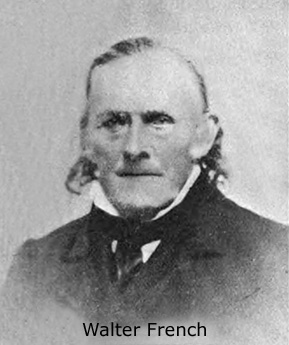
Note: Walter French was not closely related to fellow Seymour augermaker Raymond French.
In 1810, Walter French moved from Mansfield, Connecticut, to Humphreysville (now part of Seymour), a hamlet six miles above the mouth of the Naugatuck River. There, he went to work in the blacksmith shop of Ira Smith, who later served in the War of 1812. Smith's was a small, landlocked shop located a half mile from the Rimmon Falls dam (now referred to as the Tingue Dam). Walter French's considerable abilities soon became apparent, and he moved from employee to Smith's business associate. Smith's death in 1822 may have been the impetus behind French's decision to build a shop on a nearby tributary of the Naugatuck, the Little River, and go into business for himself.(1) He stamped his augers with both his given and surname, WALTER FRENCH.
Though Walter French is sometimes credited with inventing the double-twist auger, he was relatively late to the game. The first commercially viable American screw auger appeared in Pennsylvania as early as 1772. It would be more accurate to credit him with pioneering the development of the tool in his part of Connecticut. Even then, there is disagreement over French's status as the first to make the auger in the surrounding area. Some believe another local blacksmith, Jesse Hartson, did so earlier. More to the point is that Walter French believed he was the first to develop the revolutionary auger. He may have come to this conclusion following a sales trip to New York, where an effusive hardware dealer told him his screw augers were the first to be sold in the city and referred to him as an honor to his country.(2)
The life of an independent businessman may not have appealed to Walter French, for some time after 1837, he became the superintendent of his neighbor Clark Wooster's auger shop. He remained there until Wooster closed the shop in 1844. French then moved to Westville, eleven miles away, where he is reported to have gone into the auger business.(3) The 1850 federal census records Walter French as a laborer working in Westville. The 1860 census finds him living in New Haven's Eighth Ward with surveyor William Hartley and his wife, Jane, and having no occupation. Aged 79 at the time of the census, he died five years later.
Walter French took his religion seriously. In 1815, he became a licensed Methodist exhorter. Exhorters did not preach the Gospel but encouraged their friends and neighbors to live upright lives. He went on to become a licensed preacher, one step short of a minister, and traveled the local circuit when needed. A contemporary remembered Walter French as a man with "a good memory and a ready utterance," who often "spoke with great power and success."(4)
At least two of Walter French's sons went into the auger business. In 1844, the year their father moved to Westville, Wales French bought the Clark Wooster shop and began making augers there with his brother Warren.(5) Their business, the source of augers stamped W. & W. FRENCH, lasted two years, coming to an end at about the time Warren became one of the six partners to form French, Swift & Co. Wales French moved to Westville and continued to make augers, stamping them WALES FRENCH. He stuck with the auger business through at least 1857. The 1860 federal census finds him living in New Haven's Second Ward and working as an insurance agent.
On April 5, 1847, Warren French joined Charles Swift, Henry B. Beecher, John F. Marshall, Lemuel Bliss, and Horace Radford to form French, Swift & Company. The company's primary products were augers and bits. Their output was stamped, logically enough, FRENCH, SWIFT & CO. Henry B. Beecher bought out his partners one at a time until 1866, when he gained control of the company and renamed it Henry B. Beecher. Warren French followed in his father's footsteps and became a licensed exhorter and preacher in the Seymour Methodist Episcopal Church. One observer remembered, "Warren French was an exhorter whose exhortations went to the hearts of sinners as red-hot as the augers he twisted at his forge."(6)
Illustration credit:
- Walter French portrait: Basset, Frank G. “Town of Seymour.” The Connecticut Magazine: an Illustrated Monthly. v. 6, no. 5, (July-August) 1900.
References:
- Sharpe, W. C. A History of Seymour, Connecticut with Biographies and Genealogies. Seymour, Connecticut: Record Print, 1879. p. 155; Rockey, J. L., ed. History of New Haven County. vol. 2. New York: W. W. Preston, 1892. p. 574.
- Campbell, Hollis A., et. al. Seymour Past and Present. Seymour, Connecticut: W.C. Sharpe, 1902. p. 158-159.
- Campbell, p. 159.
- Sharpe, History of Seymour, Connecticut with Biographies ... p. 175.
- Campbell, p. 159, again.
- Sharpe, W. C. Annals of the Methodist Episcopal Church of Seymour, Connecticut. Edition of 1896. Seymour, Connecticut: Record Print, 1896. p. 89.
Gladwin, Porter A.
Porter A. Gladwin (1818-1887) is better known for inventing a uni-directional match plane than for inventing a unique auger bit. Gladwin registered at least eight patents: one for a corn sheller, four for hand planes, two for wood-boring bits, and one for a bench vise. Born in Connecticut, he spent his early adulthood in his home state, where he invented his corn sheller in 1840(1) and went on to become partner in the planemaking firm Gladwin & Platts and later, Gladwin & Fenn.
In the mid-1850s, Gladwin relocated to the Boston area, where he worked as a planemaker, patenting two improvements to hand planes, and eventually setting up an operation under his own name on Boston's Albany Street ca. 1868.(2) He relocated to nearby Chelsea in 1873, where he partnered with Civil War veteran Thomas Appleton, a hardware and cutlery merchant. Their planemaking enterprise, Gladwin and Appleton, was short-lived. The business went into bankruptcy just four years later.(3) Gladwin then returned to Boston, where he became sole proprietor of yet another planemaking business.
After filing for a combination plane and tool handle,(4) Gladwin became interested in a problem common to the use of wood augers: a clogged lead screw. During the boring process, fine bits of wood can get caught in the threads of a lead screw. If enough debris accumulates, the auger stops pulling itself into the wood, and progress ceases. The worker will then have to remove the auger from the target stock, clean its threads, and reinsert it into the unfinished hole before boring can continue.
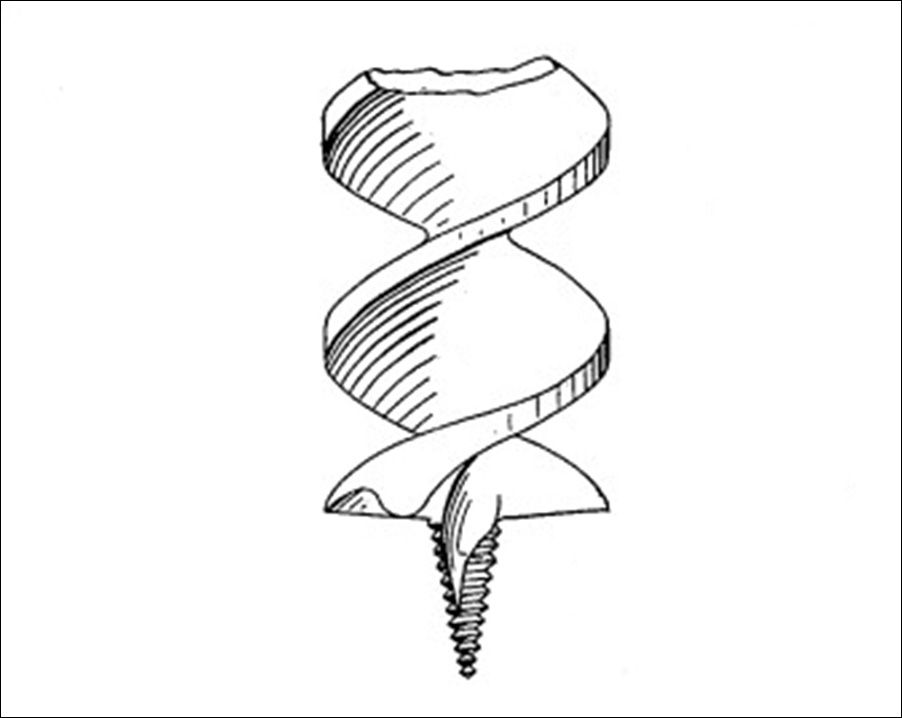
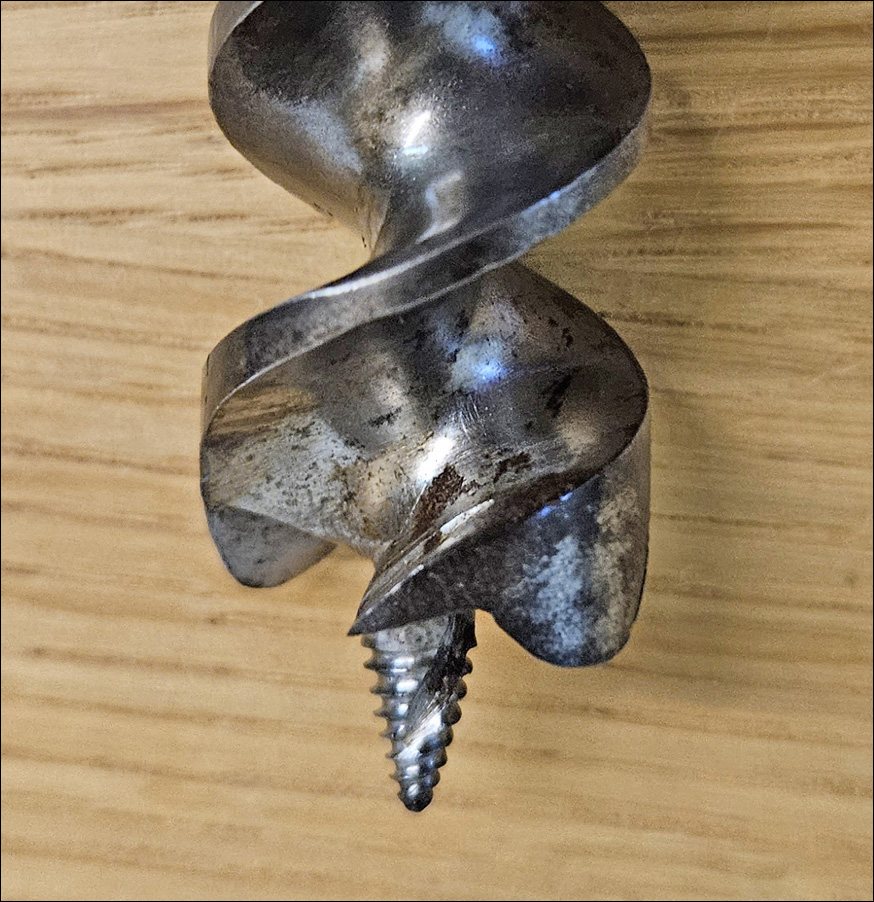
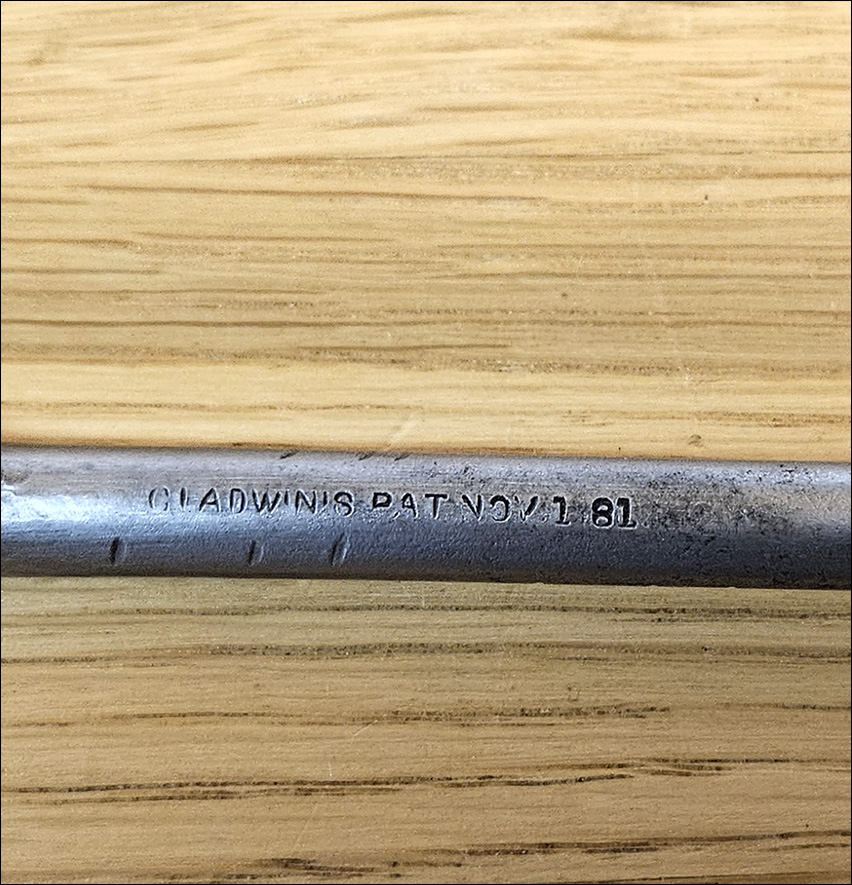
Gladwin attempted to solve the problem by continuing one or both of the channels formed by an auger's twist down across the lead screw. The grooves created by doing so were intended to allow small bits of wood to pass up out of the threads and into the twist rather than clogging the lead screw. The United States Patent Office issued a patent for Gladwin's unusual auger in the fall of 1881.(5)
The idea did not catch on, and few of Gladwin's bits have survived. The grooves in extant examples look like nothing so much as notches crudely filed into the threads of the lead screw by some blockhead woodworker. Gladwin's final patents were for an expansive bit and a bench vise. A creative inventor with a unique approach to problem-solving, Gladwin died on August 12, 1887.
- Drawing of Gladwin's bit: United States Letters Patent No. 248,854 (November 1, 1881).
- Photos of Gladwin's bit: the Author.
References:
- United States Letters Patent No. 1,567, (April 24, 1840).
- Smith, Roger K. Patented Transitional & Metallic Planes in America: 1827-1927. 2nd ed. Published by the author, 1990. p. 34-35.
- "United States District Court." The Boston Globe (Boston, Massachusetts). June 16, 1876. p. 6.
- United States Letters Patent No. 202,105, (April 9, 1878).
- United States Letters Patent No. 248,854 , (Nov. 1, 1881).
Griswold, Charles & George
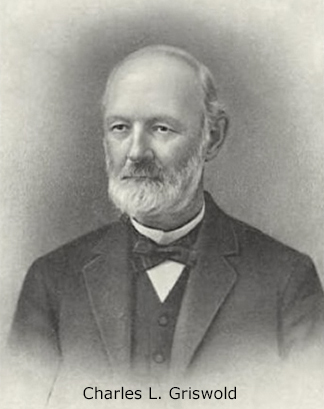
In 1851, Charles L. Griswold, his brother George G. Griswold, and Samuel Wright formed C. L. Griswold & Company and began manufacturing augers on the south branch of Pattaconk Brook in Chester, Connecticut. They set up shop in a collection of wood-frame buildings that had been painted red some years earlier. Locals referred to the works as the Red Factory to differentiate it from a nearby manufacturing operation known as the Yellow Factory.(1)
In 1854, George G. Griswold erected a new building near the Red Factory and began manufacturing augers. Two hundred twenty feet long, twenty-eight feet wide, and topped with a cupola housing the factory bell, the two-story structure was anything but humble. At about this time, George Griswold organized George G. Griswold & Company and began making augers there. A peripherally related 1881 court case suggests that Charles Griswold owned the site of his brother's operation.(2) The Red Factory continued to house the operations of C. L. Griswold & Company.
While George G. Griswold & Company identified some of its output with a traditional GEO. G. GRISWOLD & Co. mark, at times it stamped G. G. G. & CO. on the tangs of its auger bits. At some point, Jarvis Boies (also spelled Bois) became a major investor in George Griswold's operation. His participation in the business goes far in explaining the occasional appearance of bits marked GRISWOLD & BOIS.
In 1856, George Griswold patented a method for varying the thickness of the flattened plate of an auger bit before twisting. By leaving the plate thicker in the middle, rather than on the edges, Griswold hoped to improve the bit's strength and promote the freer passage of chips up the spiral by shunting them to the outer edge of the twist. His patent application was witnessed by his brother, Charles Lee Griswold, and Joshua L'Hommedieu, a prominent local auger maker.(3)
George G. Griswold & Company sold its ten-year-old factory to Turner, Day & Company on August 25, 1863. The principals, Sidney Turner and Edward Day, were George Griswold's sons-in-law and intended to manufacture ship augers and bolts. Turner, Day & Company's stay at the plant was a short one. On February 15, 1865, the Turner & Day operation quitclaimed the land back to C. L. Griswold & Company.(4) The Russell Jennings Company began producing augers in the factory later that year.
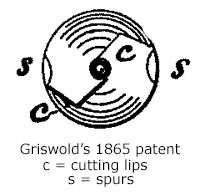
In May of 1865, Charles L. Griswold, still working in the Red Factory, patented a double-twist auger bit in which the cutting lips projected from the lead screw at nearly a right angle. Though much of the company's output consisted of standard double-spur bits with tangs stamped C. L. GRISWOLD CAST STEEL, bits protected by the new patent were manufactured. These patented bits bore the tang-stamp C. L. GRISWOLD PAT'D MAY 30, 1865. Charles Griswold went on to secure a pair of patents for gimlet handles in 1872 and 1873.(5) A patent for a bitstock followed in 1878, and one for a corkscrew in 1884.(5) The bit-stock may not have been manufactured.(6)
The Red Factory burned to the ground on October 15, 1878. Though the nearby office and outbuilding were saved, between sixty and seventy thousand unfinished auger bits were lost. Charles Griswold promptly began construction of a replacement, and a new factory was in place three months later.(7) In 1884, he leased the new building to his son-in-law, Edwin G. Smith, and Smith's partners, John H. Bailey and Charles E. Wright. The three partners went into business as the Chester Manufacturing Company and produced auger bits, reamers, and corkscrews.(8)
Illustration credits:
- C. L. Griswold portrait: https://www.findagrave.com/memorial/31462312/charles-lee-griswold (viewed March 22, 2023).
- 1865 patent auger image: United States Letters Patent No. 14,561, (April 1, 1856).
References:
- Silliman, Kate. Kate Silliman's Chester Scrapbook. Chester, Connecticut: Chester Historical Society, 1986. p. 110, 146-147.
- Blatchford, Samuel. Reports of Cases Argued and Determined in the Circuit Court of the United States for the Second Circuit. Vol. 19. New York: Baker & Vorhis Company, 1883. p. 95.
- United States Letters Patent No. 14,561, (April 1, 1856).
- Blatchford, p. 95-96.
- The gimlet handles: United States Letters Patent No. 133,440, (November 26, 1872); and United States Letters Patent No. 143,142, (September 23, 1873).
- The bit stock: United States Letters Patent No. 208,168, (September 17,1878); The corkscrew: United States Letters Patent No. 302,331, (July 22, 1884).
- "Middlesex." Hartford Daily Courant (Hartford, Connecticut). Vol. 42, no. 245, October 17, 1878. p. 4.
- Silliman, Kate. Kate Silliman's Chester Scrapbook. Chester, Connecticut: Chester Historical Society, 1986. p. 147.