Ransom Cook and His Auger
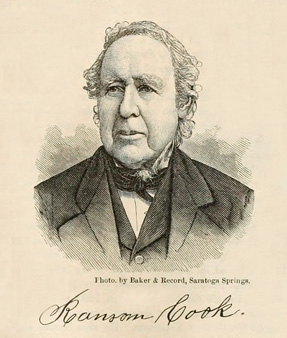
Born the son of a furniture maker in 1794, Ransom Cook spent his early years in the Milton, New York, shop of his father. By the age of ten, he was making "common chairs" in their entirety—turning the posts and rounds in a lathe, constructing the frame and seat, and applying the final coats of paint or varnish. At age twelve, the precocious lad built electrical shocking devices for several area doctors who believed the machines' vigorous jolts would cure previously untreatable ailments.(1) Though he had never seen an example, Cook designed his instrument based on what he had gleaned from drawings and his extensive reading. The younger Cook opened a furniture shop near that of his father when he was nineteen, and nine years later, he moved the business to Saratoga Springs.
Cook used a steam engine to power his shop, and surviving account books indicate the business produced decorative boxes, bedsteads, tables, chairs, and coffins. In 1843 alone, Cook sold 340 chairs, fifty-six bedsteads, sixty-five tables, and twenty-eight coffins.(2) Extant examples of his work indicate that much of his high-quality output was painted and embellished with elaborate stenciled designs. In addition to furniture, he sold turpentine, varnish, pigments, and japanning. A gifted and inventive man, Cook retained his enthusiasm for scientific and electrical devices and became interested in metallurgy. He soon filled his workshop with the latest in scientific gadgets and metalworking equipment.
In 1836, Ransom Cook made the acquaintance of Thomas Davenport, the man credited with inventing the electric motor. Davenport was in the Saratoga area demonstrating his creation when Cook saw the possibilities inherent in the device and agreed to finance its development and collaborate on its improvement. Their combined efforts led to the electromagnetic motor Davenport patented on February 25, 1837. The application was witnessed by Cook's son, Charles, and W. W. Ayres, Cook's brother-in-law (also spelled Ayers). Cook and Davenport went on to form the Electro-Magnetic Joint-Stock Association, an enterprise that folded shortly thereafter when the primary investor failed to make payment on his shares. At that point, Cook lost his investment in the project, and Davenport never found the backing to make his dream a reality. The original model of Davenport's electric motor remains on display at the Smithsonian Institution.(3)
Warden of Clinton State Prison
In 1842, the Assembly of the State of New York commissioned Ransom Cook to study the feasibility of using convict labor to conduct mining operations on lands in the northern part of the state. Cook concentrated his efforts on the iron-mining sites in Clinton and Essex Counties. In his 1843 report, he recommended that the state purchase the Sailley, Averill, and Skinner veins, located seventeen miles from Plattsburgh and some five miles from a waterpower on the Saranac River. His detailed, optimistic report went beyond that expected of him and included recommendations for the design and construction of the prison itself.

Based on Cook's recommendations, the Assembly passed legislation the following year to construct a prison on the site he had selected and named him agent and warden of the facility. The project was controversial from the start, with objections to the practicality of the venture dating back to the filing of Cook's report.(4) Undeterred, Cook began by ordering the construction of temporary housing for staff and prisoners, and on June 3, 1845, the first inmates arrived in chains. He had traveled to Sing Sing and Auburn to select candidates for his project based on their robust health and physical strength. On their arrival, the work of building the prison began in earnest. Eighteen months later, in January 1847, the grounds for the prison had been leveled, water brought into the yard, a quarry established, stone foundations sunk, and the mouth of the mine opened. Despite the herculean effort, less than $500 of iron ore had been extracted.
Taxpayers expecting a quicker return on investment failed to grasp the time and effort required to build a prison and open a mine in a remote wilderness. Critics of the project were vocal, and when the iron ore—though suitable for producing pig iron—proved to be of lower quality than expected, Cook faced harsh criticism.(5) A political appointee, he remained at his post until 1848, when the Whig Party took control of the Statehouse. His tenure as warden had been less than three years.
The production of iron at the prison was minimal until 1854, when a blast furnace was completed. The operation was never really profitable and shut down in 1877.(6) The Clinton State Prison, located in Dannemora, remains in operation today as the Clinton Correctional Facility. At a time when wardens made liberal use of the cat-of-nine tails and hung prisoners by the thumbs on a device called the Trapeze, Ransom Cook's humane approach to discipline and progressive correctional philosophy stood out as remarkably enlightened.
Patents and more patents
Ransom Cook patented or co-patented two inventions on February 1, 1842.(7) The first, co-patented with fellow Saratogan S. E. Burnham, was for a device for tensioning blades in sawmills. The second was Cook's solo patent for a process for making wrought iron and steel cannons. Cook tried to interest the United States Department of War in his idea, but failed to do so. An Englishman, Sir William Armstrong, obtained a copy of the document, adapted the idea, and signed his patent rights to the British government. Armstrong's novel gun became the basis for a family of breech-loading cannons that became known as Armstrong guns.(8)
During his tenure as warden of Clinton Prison, Cook became interested in the processing and smelting of iron. While there, he developed a machine that inmates used to separate the iron in ore from the waste. He didn't patent the device until the year after he left his post at the prison. The Patent Office awarded him protection for the device with United States Letters Patent No. 6,121. The text of the patent is hard-going and not nearly as poetic as a description of the machine found in a Georgia newspaper.
The ore, spread on a sheet, is moving in one direction, while the electro-magnets, without charge, are quietly moving in the opposite one. On sight of the ore these hitherto passive bits of iron become instantly electrified, when the ore and magnets embrace each other with all the ardor of long absent lovers. Thus united they move a short distance together, when the electro-magnets, as if seized with a new caprice, lose their attraction and drop the too confiding ore, which then, like a disappointed lover plunges into the stream, where its sorrows are drowned.(9)
Cook went on to earn another thirteen patents and one extension. Five were for pipes, fans, and blowers that might be adapted for use on a blast furnace. Five dealt with the production of bits for boring holes in wood; one concerned the ventilation of railroad cars; another, an improved pair of scissors; and one, an improved lunch bucket.
Cook's auger bit
Ransom Cook met with his greatest success with the gouge-lipped auger he patented on June 17, 1851.(10) His invention met with widespread acceptance, and the royalties he earned from it were largely responsible for the comfortable life he enjoyed in Saratoga Springs. The inspiration for his invention came from observing the jaws of a wood-working beetle. According to one account:
In his chair making he had for a long time tried to invent an auger, which would bore at an angle with the grain, but without success. One Sunday he went for a walk in the woods north of Broadway in Saratoga and sat down on a log to rest. He noticed some insects working in the wood and noticed the holes they were making were perfectly round. He went home and got an ax and returned to cut out pieces of the log containing the insects and the holes they had made. Later he examined them with a powerful microscope and discovered their secret for making round holes. He made a model of Cook's ager and patented it. The royalties that makers of augers paid him gave him a very comfortable income.(11)
Cook’s insight came less from the beetle’s method than from the shape of its jaws. While the insect cut wood fibers with a lateral, shearing motion, Cook’s bit achieved a similar effect through rotation. Never shy about recounting the story behind his design, Cook enjoyed sharing the origins of his invention. To this day, his auger is sometimes referred to as the beetle bit.
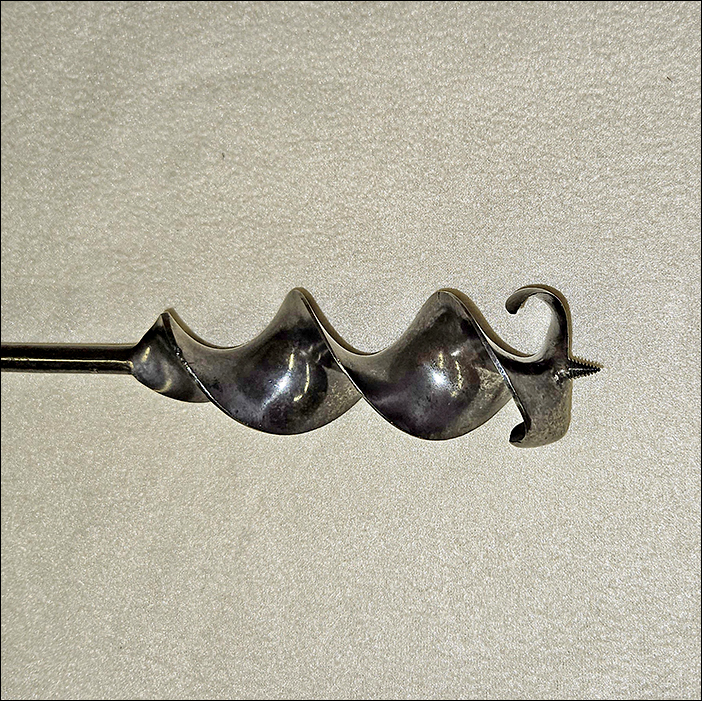
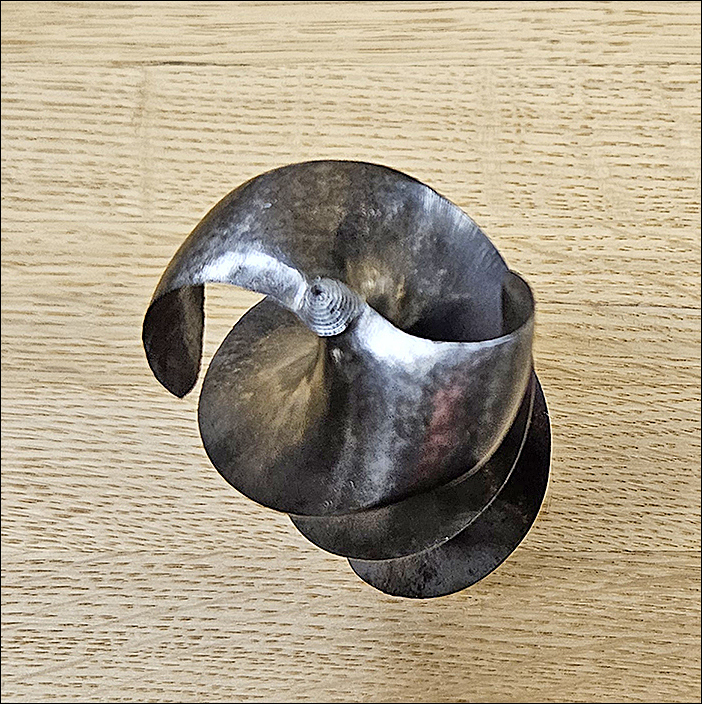
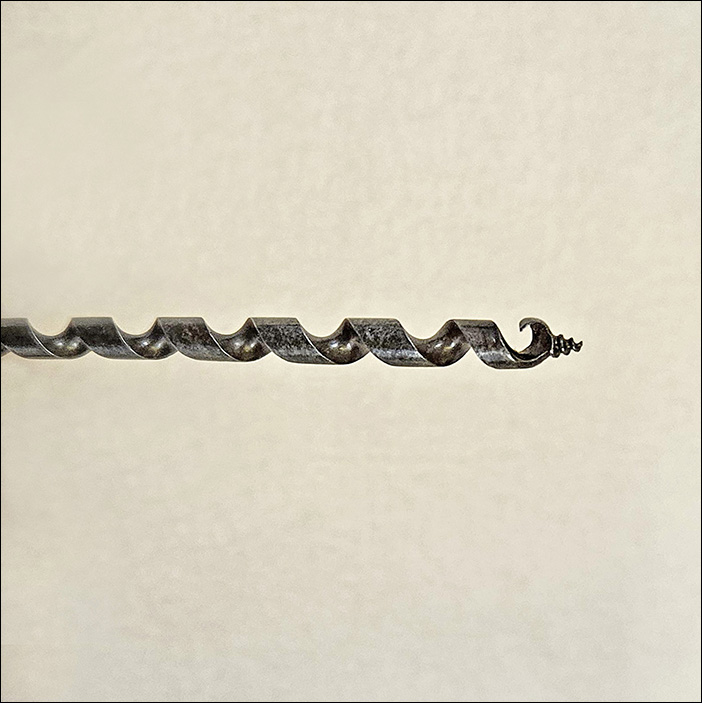
Since there were no spurs to catch the surface of the wood and deflect it, Ransom Cook's bit proved effective in boring end grain and worked well at shallow angles. As good as the bit was, the design broke down on the smaller sizes because the configuration of its cutting lips made its production and the sharpening of smaller sizes difficult. The solution to the problem was to manufacture the smaller bits (nos. 3 through 6) as single-twist augers with just one cutting lip.
Just how quickly Ransom Cook licensed the rights to put his bit into production remains a matter of speculation. In August of 1854, John Gedge, an English patent agent, registered Cook's design at the Patent Office of Great Britain.(12) The award came several months later. (Patent agents advised and assisted inventors going through the complex process of getting a patent. Many were not lawyers and couldn't argue a rights case in court.) Gedge either purchased the right to manufacture Cook's bit outright or worked out a royalty arrangement that allowed him to manufacture it in Britain. His association with the auger resulted in it being referred to as "Gedge's pattern" in the British Empire, rather than "Cook's pattern," the term used in the United States.
Shelburne Falls production
Ransom Cook formed a business known as Cook, Lamson, & Co. and began making augers in Shelburne Falls, Massachusetts, as early as 1853, and continued doing so through at least 1856.(13) The company existed as an entity distinct from noted cutlery manufacturer Lamson & Goodnow, though the other principal in Cook's enterprise was either Nathaniel or Ebenezer G. Lamson, brothers and major stockholders in the Shelburne Falls knife maker.
Cook relocated to attend to his Shelburne-based business. The 1855 Massachusetts State census shows Ransom Cook, a manufacturer, living in Shelburne, Massachusetts, with his wife Rachel and two sons. On March 27 of that year, Cook patented a machine for turning the lips of augers.(14) While the patent application doesn't specifically mention the use of the machine for making gouge-lip augers, the accompanying illustrations show its obvious utility for making the heads of augers of Cook's design. Eight months later, the Patent Office awarded him United States Letters Patent No. 13,780 for a set of dies to be used in making his bits. By the time of the 1860 federal census, Cook and his family had moved back to Saratoga. They returned earlier—around the time he completed the work of getting his bit into production. Cook, Lamson & Co. had gone out of business by then, and Larson & Goodnow were manufacturing Cook's unique auger, an arrangement that continued through at least 1865.(15) Cook pattern bits manufactured by Lamson & Goodnow can be identified by the stamp L. & G. MFG. CO. COOK’S PAT. 1851.
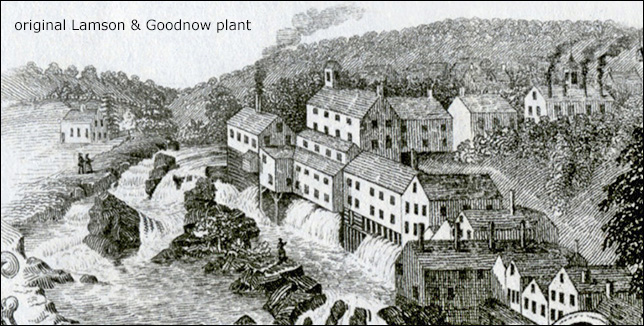
In 1865, Ransom Cook succeeded in having the United States patent for his so-called “beetle bit” extended for seven years. In doing so, he employed a strategy common among patent holders of the time: applying for the simultaneous reissue of the patent. Savvy inventors often sought both: the extension to lengthen the term of protection, and the reissue to broaden the original claim. The Patent Office granted the extension because Cook demonstrated that he had been deprived of fair remuneration for the time, ingenuity, and expense invested in developing and marketing his bit. The Office reissued the patent to correct errors in the text and drawings of the original claim—not to extend it.(16) Cook bits bearing the stamps PAT. EXT’D JUNE 17, 1865 and PAT. EXT’D JUNE 17, 65 are frequently seen.
Douglass Manufacturing & James Swan
A notice in the December 1867 issue of Scientific American informed readers that the Douglass Mfg. Company, of Seymour, Connecticut, had become the exclusive manufacturer of Cook's auger.(17) Douglass Manufacturing, a maker of edge tools headquartered in Shaftsbury, Vermont, had begun producing augers and bits in Seymour in 1856, siting its operation in a factory that once housed the Upson Mfg. Company, one of the area's early augermakers. The Douglass family no longer owned the business when Cook augers began rolling off the line.
Frederick Lothrop Ames, the twenty-nine-year-old scion of the family who owned Oliver Ames & Sons, a noted Massachusetts shovel maker, bought the Douglass factories in 1860 and continued operating them under the Douglass Manufacturing Company name. The responsibility for getting the new line of Cook bits off the ground fell to Ames's new plant superintendent, James Swan, a talented man who would one day own the company. Cook pattern bits made by Douglass Manufacturing were routinely stamped D. M. CO. COOK’S PAT. The operation's other auger bits, mostly the double-spur type, bore such designations as D. MFG. CO. or D. MFG. CO. EXTRA. Frederick L. Ames consigned the output of his factories to the Russell & Erwin Company of New Britain, Connecticut, which sold the tools through its New York office.
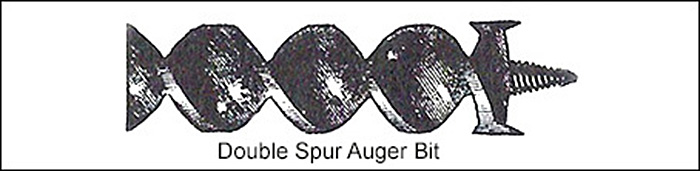
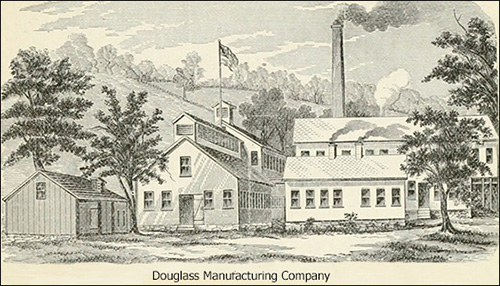
Production of Cook's bit continued at the Seymour plant through three rapid-fire changes of ownership—most likely the result of the Business Panic of 1873. In that year, Thomas Douglass and Richard P. Bruff, the manager of Russell & Erwin's New York Office, bought Douglass Manufacturing Company from F. L. Ames. They, in turn, transferred ownership of the business to James Flint and the Russell & Erwin Mfg. Company the following year.(18) Three years later, plant superintendent James Swan bought the business.
The complex cutting head of Cook's auger was not the easiest to manufacture, and Douglass Manufacturing's superintendent, James Swan, developed a machine that simplified the process. He had the foresight to patent it in 1868 and then had the patent twice reissued.(19) Swan assigned the rights to the machine to company co-owner, Richard R. Bruff, at the time of its 1873 reissue. The following year, when the patent for Ransom Cook's bit expired, W. A. Ives & Company used an infringing machine to make Cook-type bits. The case, Bruff vs. Ives, played out in the courtroom of judge Nathaniel Shipman of the Connecticut District of the U. S. Circuit Court. Ives & Company argued that Swan's innovation added nothing but a die to a machine patented by Ransom Cook twenty years earlier. Judge Shipman did not agree and found for Bruff.(20)
In 1880, Ives & Company found themselves once again at the center of a dispute involving Ransom Cook's bit—this time with the James Swan Company. The Swan organization took Ives & Company to court to stop their manufacture of a knockoff of Cook's gouge-lip auger known as the Ives New Circular Lip Improved Bit. Though the extended patent for the Cook bit had expired, the patents on the machinery to produce it efficiently had not. Since the equipment in question was useful for the manufacture of all sorts of bits, Ives & Company had acquired it from the Swan Company's predecessor, Douglass Manufacturing, with the stipulation that it not be used to produce Cook-type augers. Ives used the machinery to make copycat augers anyway, and his company was subsequently brought before the Connecticut Court of Common Pleas, which enjoined the Ives company from continuing its production of the bit.(21)
Ives & Company either reached an agreement with James Swan or found a way to manufacture the bits without Swan's equipment. Notice of discounts for the Ives Circular Lip auger appeared in the trade literature from 1880 through at least 1898, often appearing next to listings for Cook's Circular Lip augers made by the New Haven Copper Company and James Swan.
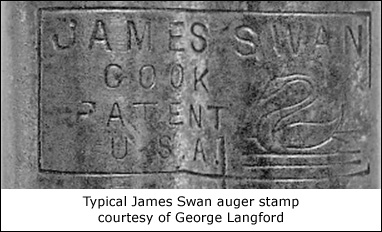
For decades, the Swan Company marked its gouge-lipped augers and bits JAMES SWAN COOK PATENT. The text was typically accompanied by a line drawing of a swan. In the early 20th century, the stamp was modified to read: JAMES SWAN COOK PATENT U. S. A. The company continued to produce Cook-type auger bits until 1951. By then, the market for the bit had become highly specialized. The examples in the 1951 catalog were marketed as bits for tapping trees.(22)
Ransom Cook: epilogue
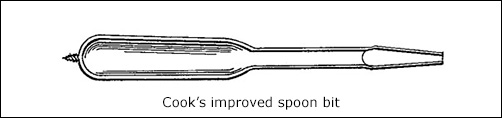
The United States Patent Office awarded Ransom Cook his last patent on August 18, 1868. United States Letters Patent No. 81,069 protected his design for adding a lead screw to a spoon bit. Though Cook claimed more accuracy in starting the bit, it did not meet with acceptance. A marked example has yet to surface. Cook was seventy-two at the time of his invention, and there is little evidence that afterward he was active in politics, correctional facilities, or tool design.
Ransom Cook maintained an impressive personal library. His obituary in the New York Times reported that he had " ... accumulated one of the most complete and valuable collections of scientific and mechanical books in the country. His library contains 3,000 volumes, many of them exceedingly rare."(23) As might be expected from a man like Cook, he considered standard book shelving inadequate for his purposes. The article continues: "The books are arranged in small cases, piled one on top of the other, from floor to ceiling. The purpose of this arrangement was to have them ready for rapid removal in case of fire."
In 1877, nine years after his improved spoon bit, Ransom Cook suffered a severe fall from which he never fully recovered. He seldom left his home afterward. Sometimes referred to as the "Master of Twenty-Six Trades and Owner of 17 Patents," he died on May 28, 1881, in Saratoga Springs. The author has yet to find a list of the twenty-six trades mastered by Ransom Cook.
Illustration credits:
- Ransom Cook Portrait: Sylvester, Nathaniel Bartlett. History of Saratoga County, New York: with Illustrations and Biographical Sketches. Philadelphia: Evert & Ensign, 1878.
- Prison torture: Benson, Michael. Escape From Dannemora. Lebanon, New Hampshire: University Press of New England, 2017.
- Cook's auger bit: author's photos
- Lamson & Goodnow plant: Special Collections and University Archives, UMass Amherst Libraries. Lamson and Goodnow Records. http://scua.library.umass.edu/lamson-and-goodnow
- Douglass Manufacturing plant: Sharpe, William C., Seymour and Vicinity: Historical Collections. Seymour, Connecticut: Record Print., 1878.
- James Swan bit stamp: composite image courtesy of George Langford, proprietor of the website George's Basement.
- Cook's improved spoon bit: United States Letters Patent No. 81,069, (August 18, 1868).
References:
- Sylvester, Nathaniel Bartlett. History of Saratoga County, New York: with Illustrations and Biographical Sketches. Philadelphia: Evert & Ensign, 1878. p. 205.
- MacMorris, Mary. "Ransom Cook." The Decorator. vol. 10, no. 2, (spring 1956), p. 4.
- Cook, N. Nelson Cook: American Portraits, 1808-1892. http://nelsoncook.com/letters-from-canada. (viewed 4/5/2025)
- "State Prison Labor." Schenectady Reflector (Schenectady, New York). March 17, 1843. p. 2
- "The Agent of the Clinton Prison and his Report." Essex County Republican (Keeseville, New York), January 23, 1847. p. 2.
- Pollard, Gordon C. and Haagen, Klaus D. Large Business: The Clintonville Site, Resources, and Scale at Adirondack Bloomery Forges. https://historycooperative.org/journal/bloomery/ (viewed April 4, 2025)
- United States Letters Patent No. 2,444, (February 1, 1842); United States Letters Patent No. 2,443, (February 1, 1842).
- Sylvester, p. 205; also "William Armstrong, 1st Baron Armstrong." Wikipedia. https://en.wikipedia.org/wiki/William_Armstrong,_1st_Baron_Armstrong (viewed 4/14/2025)
- "Electro-Magnetic Ore Separator." Weekly Chronicle & Sentinel (Augusta, Georgia), March 15, 1848, p 2.
- United States Letters Patent No. 8,162, (June 17, 1851).
- MacMorris, p. 4.
- "Letters Patent to John Gedge ..." Specifications of Inventions... No. 1872. London: Patent Office of Great Britain, 1854.
- The Massachusetts Register for the Year 1853 ... Boston: George Adams, 1853. p. 106; The Massachusetts Business Directory for the Year 1856. Boston: George Adams, 1856. p. 102.
- United States Letters Patent No. 12,583, (March 27, 1855).
- New England Business Directory. Boston: Adams, Sampson & Co., 1865. p. 362.
- United States Letters Patent Reissue No. 2,518, (March 19, 1867).
- [Notice]. Scientific American. new series vol. 17, no. 23 (December 7, 1867). p. 367.
- "Gautier v. Douglass Manufacturing Co." Reports of Cases Heard and Determined in the Supreme Court of the State of New York. Vol. 20, 1878. New York: Banks & Brothers, 1878. p. 514-525.
- United States Letters Patent No. 78,769, (June 8, 1868); United States Letters Patent Reissue No. 4,516, (August 15, 1871); United States Letters Patent Reissue No. 5,624, (October 21, 1873).
- Banning, Hubert A. and Henry Arden. Reports of Patent Cases Decided in the Circuit Courts of the United States since January 1, 1874: Vol. II. New York: L. K. Strouse, 1882. p. 595-600.
- "Court of Common Pleas—Judge Harrison." New Haven Morning Journal and Courier (New Haven, Conn.), Dec. 17, 1880. p. 4.
- Swan Catalog No 51: 1951. Seymour, Connecticut: James Swan Company, 1950. p. 7.
- "Burial of Ransom Cook." The New York Times (New York, New York), June 1, 1881. p. 5.