Millers Falls Planes
The bench planes
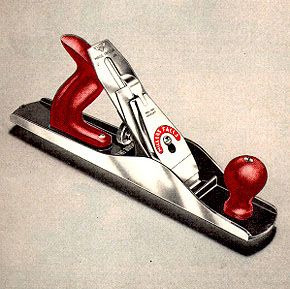
When the Millers Falls Company introduced its new line of hand planes in 1929, it needed a way to differentiate its products from those already on the market. The identity problem was compounded by the fact that all of the new models were knock-offs of existing Stanley production. The company chose to build product identity by concentrating its publicity on the new line’s flagship tools—the bench planes.
The planes were developed with an eye to creating an instantly recognizable appearance that would set them apart from the competition. Their frogs, painted with bright red enamel, contrasted sharply with the planes’ black-enameled beds. (Frog incorrectly colored black in this illustration.) The company used mirror-bright nickel plating for the lever caps of its premium bench planes and displayed the company name on them, surrounded by bright red paint.
The other way chosen to distinguish the bench planes was the promotion of the design of their jointed lever caps. The standard lever cap used by competitors applied pressure to the chip breaker/cutter assembly at two points—one at the point of contact with the cap’s cam lever, the other along the lower edge where it made contact with the hump of the chip breaker. The hinged cap was designed to apply force to the chip breaker/cutter assembly at a third point, just above the chip breaker hump. Three points, rather than two—the company advertised the arrangement as a method for preventing chatter. The jointed lever cap was developed by Charles H. Fox, a Millers Falls employee who assigned the patent to the company. The Fox lever cap was expensive to produce. The company switched to a traditional Bailey-type lever cap in 1966, a move that coincided with a general decline in the quality of its hand-powered tools.
The Millers Falls Company never offered the Fox cap on its less expensive bench planes. The economy planes were initially marketed as part of the Mohawk-Shelburne line of economy tools. Later versions of the company's economy planes bore the Millers Falls trademark. The company also manufactured several intermediately priced planes, all equipped with traditional lever caps. The most unusual of these featured beds with teflon-coated sides and soles.
When it closed its foundry in 1969, the company outsourced the production of all of its castings. A half dozen years later, it was buying generic hand planes from third-party vendors and relabeling them. Unfortunately, the third-party tools were third-rate, leaving the company's reputation for quality hand planes in the dust.
The block and specialty planes
Twenty-eight of the planes introduced during the 1929 rollout were smaller-sized block planes or special application planes rather than bench planes. Information about them can be found on the Block & Specialty Planes Page.